
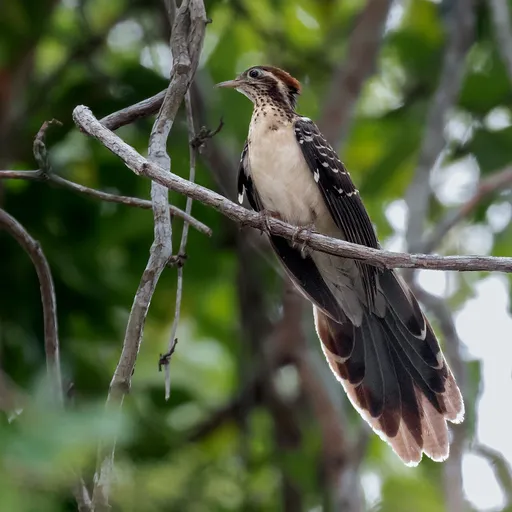
Pheasant Cuckoo
Dromococcyx phasianellus
Least Concern
Overview
The pheasant cuckoo (Dromococcyx phasianellus) is a species of neotropical cuckoo belonging to the subfamily Neomorphinae. It is a large, brood parasitic bird native to Central and South America, where it inhabits lowland tropical forests.
Identification
- Large cuckoo with dark sooty-brown upper parts and pale buff underparts featuring small black streaks on the breast.
- Possesses a short crest tipped with rusty brown and a large tail with varying feather lengths, the central ones being longest.
- Call consists of two short whistles, the second of higher pitch, followed by a trill described as "whee! whee! wheerr-rr".
- May display white spots on partially extended wings during strutting.
Habitat
Found in the understorey of tropical lowland evergreen, riverine, and deciduous forests from sea level up to 1600 m. Its range spans across Central and South America, including countries such as Mexico, Colombia, Brazil, and Argentina.
Diet
This insectivorous species feeds on grasshoppers, cicadas, beetles, and occasionally small lizards or nestlings. It forages on the ground by vibrating its plumage and bill while bobbing its body, followed by lunging forward to peck in the leaf litter.
Did you know?
The bird exhibits a stylized terrestrial foraging behaviour that involves making rattling sounds by vibrating its plumage and clapping its bill while bobbing its body, wings, and tail before lunging to peck at prey.
Sources
- Wikipedia · CC BY-SA 4.0
- Wikidata · CC0 1.0