
East Andean Antbird
Drymophila caudata
Least Concern
Overview
The East Andean antbird (Drymophila caudata) is a species of bird in the family Thamnophilidae that is endemic to Colombia. It is currently assessed as Least Concern by the IUCN, although its estimated population of 3,000 to 6,700 mature individuals is believed to be decreasing.
Identification
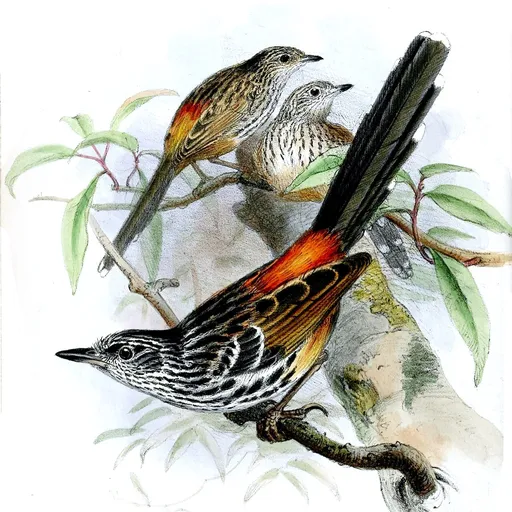
- Males measure 14.5 to 15.5 cm in length and feature a black crown and back with white streaks, a white patch between the scapulars, and a rufous rump.
- Male underparts consist of a white, heavily black-streaked face, throat, and breast, an unstreaked white belly, and rufous flanks.
- Females resemble males in pattern but have a cinnamon-rufous and black streaked crown, lack the white interscapular patch, and display rufous-buff tinges on the underparts.
- The song begins with four to six rising notes, distinguishing it from other Drymophila species that typically start with two even-pitched introductory notes.
Habitat
This species inhabits the understorey to mid-storey of montane evergreen and secondary forests in Colombia, with a preference for bamboo thickets and other dense undergrowth such as vine tangles and shrubby forest borders. It has a disjunct distribution on the west slope of the Eastern Andes in Santander Department and further south in the upper Magdalena River Valley in Caquetá and Huila departments, potentially reaching elevations up to 3,150 m.
Diet
The specific diet and feeding behavior of the East Andean antbird are poorly documented but are presumed to resemble those of the streak-headed antbird, involving primarily insects and spiders. It forages alone, in pairs, or in family groups, often joining mixed-species flocks, and typically feeds between 1 and 15 m above the ground, especially within bamboo. Prey is acquired by reaching or lunging from a perch and making short sallies to overhanging vegetation, though the species does not follow army ants.
Did you know?
Despite being classified as Least Concern, the East Andean antbird's population is estimated to be decreasing, likely due to large-scale forest loss and the removal of bamboo stands for selective logging and agricultural conversion.
Sources
- Wikipedia · CC BY-SA 4.0
- Wikidata · CC0 1.0