
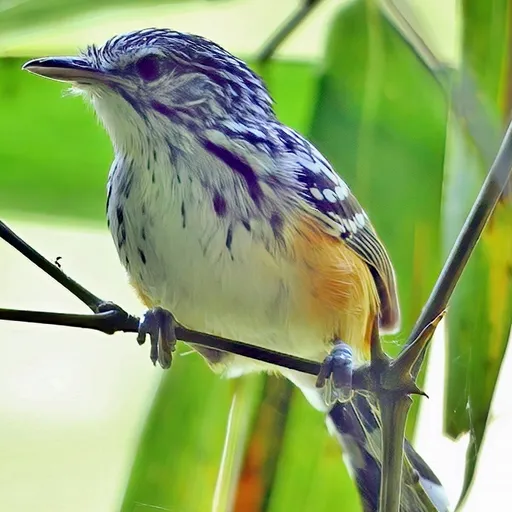
Striated Antbird
Drymophila devillei
Least Concern
Overview
The striated antbird (Drymophila devillei) is a species of bird in the family Thamnophilidae, known as the typical antbirds. It is classified as Least Concern by the IUCN, although its population size is unknown and believed to be decreasing.
Identification
- Measures 13 to 14 cm in length and weighs 10 to 12 g, featuring a brown iris, black maxilla, and blue-gray legs.
- Adult males of the nominate subspecies display a black crown and back with thin white streaks and a large white patch between the scapulars, contrasting with a white face and underparts marked by bold black streaks.
- Females share the male's pattern but with buff streaks on the upperparts and pale buff underparts with thin black breast streaks, while juveniles have olive-gray upperparts.
- The song consists of two parts: several harsh, buzzing notes followed by an accelerating series of peeping whistles described as 'chewDJZZ-DJAA-DJAA tew-tew-ti-ti-titutututututu'.
Habitat
Found in Bolivia, Brazil, Colombia, Ecuador, and Peru, the species inhabits the understorey of humid evergreen forest, almost entirely within stands of Guadua bamboo. Elevations range from 300 to 1,300 m, with the nominate subspecies having a disjunct distribution across northern South America and D. d. subochracea found south of the Amazon.
Diet
The diet is not known in detail but consists primarily of insects, with a possible preference for caterpillars, and probably also includes spiders. Foraging typically occurs in pairs or family groups within bamboo thicket crowns up to 7 m high, though sometimes as high as 20 m, and the bird often joins mixed-species flocks.
Did you know?
The subspecies D. d. subochracea is sometimes referred to as the 'Xingu antbird', a common name that can lead to confusion with the distinct Xingu scale-backed antbird (Willisornis vidua).
Sources
- Wikipedia · CC BY-SA 4.0
- Wikidata · CC0 1.0