
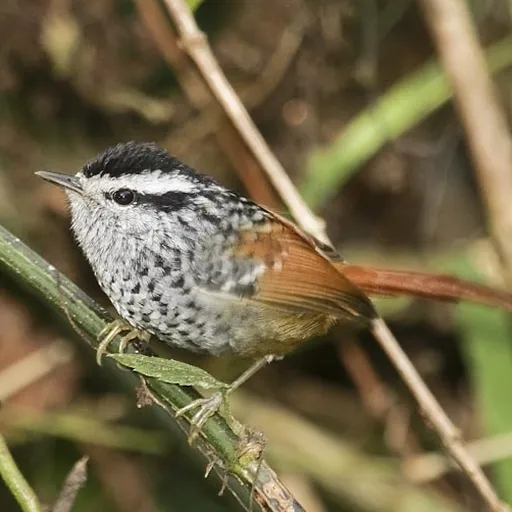
Rufous-tailed Antbird
Drymophila genei
Least Concern
Overview
The rufous-tailed antbird (Drymophila genei) is a species of bird in the family Thamnophilidae, endemic to Brazil. It is classified as Least Concern by the IUCN Red List, although its population is believed to be decreasing due to habitat conversion and fire.
Identification
- Males feature a black crown, white supercilium, and black eye band, with white cheeks speckled in black; their rump and tail are rufous.
- Females have a rufous-brown crown and nape with blackish streaks, a whitish supercilium, and buff cheeks.
- The species is 13 to 14 cm (5.1 to 5.5 in) in length.
- The song consists of 6–7 notes beginning with a very high 'sih' and jumping to lower nasal 'theèh' notes, sounding like 'síhtjeè-tjeèh-tjeèh'.
Habitat
It inhabits bamboo stands in montane evergreen forest, adjoining viny plots, and other dense foliage in southeastern Brazil. Its range includes southeastern Minas Gerais, southern Espírito Santo, northeastern São Paulo, and Rio de Janeiro, typically at elevations between 1,150 and 2,200 m.
Diet
The bird feeds mostly on a wide variety of arthropods, foraging individually, in pairs, or in family groups usually within 3 m of the ground. It gleans prey from leaves, vines, and stems by reaching and lunging from a perch, occasionally joining mixed-species flocks or following army ant swarms.
Did you know?
Although it is a year-round resident, the rufous-tailed antbird may make local movements when the bamboo stands it relies on for habitat die out.
Sources
- Wikipedia · CC BY-SA 4.0
- Wikidata · CC0 1.0