
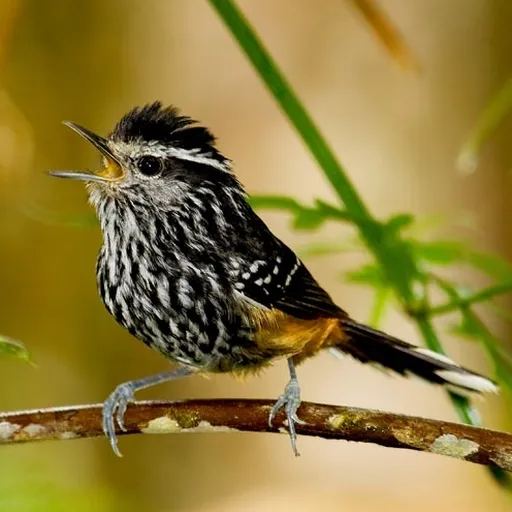
Ochre-rumped Antbird
Drymophila ochropyga
Least Concern
Overview
The ochre-rumped antbird (Drymophila ochropyga) is a species of bird in the subfamily Thamnophilinae, known as one of the typical antbirds. It is endemic to Brazil and is considered a bamboo specialist, with its population believed to be decreasing despite a Least Concern conservation status.
Identification
- Measures 12.5 to 13.5 cm in length.
- Adult males feature a black crown, long white supercilium, and a black eye band, with white cheeks speckled with black.
- Males display a light rufous rump, rufous flanks, and a white throat and breast with heavier black streaking on the breast.
- Females have a buff-streaked crown, an olive-grey back, and duller, less heavily streaked underparts.
- Song consists of a two-note 'tí-zzzzèh', with the first note high and sharp and the second drawn-out and hoarse.
Habitat
Found in the Atlantic Forest Mountains EBA in southeastern Brazil, ranging from central and southeastern Bahia through eastern Minas Gerais, Espírito Santo, and São Paulo to eastern Paraná and Santa Catarina. It primarily inhabits the understorey of bamboo and vine thickets in montane evergreen forest, but also occurs locally in lowland evergreen forest, typically between 300 and 1,950 m in elevation.
Diet
Feeds mostly on a wide variety of arthropods, usually foraging within 3 m of the ground. It gleans prey primarily from dead leaves by reaching or lunging from a perch, actively hopping through bamboo stands and vine tangles while flicking its tail.
Did you know?
Despite being classified as Least Concern, the species is believed to be decreasing in population due to threats such as urbanisation, industrialisation, and agricultural expansion. Episodic large-scale die-offs of bamboo can cause periodic fluctuations in local populations, potentially forcing the bird to make local movements when its primary habitat is lost.
Sources
- Wikipedia · CC BY-SA 4.0
- Wikidata · CC0 1.0