
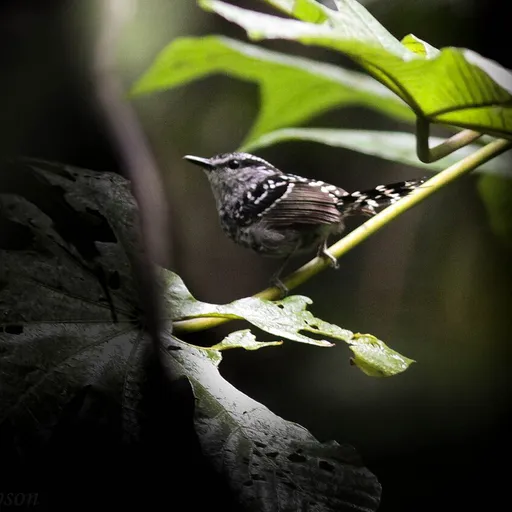
Scaled Antbird
Drymophila squamata
Least Concern
Overview
The Drymophila squamata, or scaled antbird, is a species of bird in the subfamily Thamnophilinae. It is endemic to eastern and southeastern Brazil, where it is considered fairly common to common and classified as Least Concern on the IUCN Red List.
Identification
- Length ranges from 12 to 14 cm, with a weight of 10.5 to 11 g.
- Males of the nominate subspecies have a black crown with white spots, a wide white supercilium, and a black eye stripe on a white face, while females feature dark brown and buff variations.
- Wings are black with wide white tips in males or buff tips in females, and the tail is barred with black and white.
- Song is described as a high, calm series of 4-7 sharp, descending notes, accompanied by abrupt 'pip' calls and short rattles.
Habitat
This species inhabits the dense understorey of evergreen forests and secondary woodlands in eastern and southeastern Brazil, ranging in elevation from sea level to 1,100 m. It occurs in the eastern parts of Pernambuco, Alagoas, and Bahia, as well as further south into Minas Gerais, Espírito Santo, and Santa Catarina.
Diet
The bird feeds primarily on a variety of arthropods, foraging individually, in pairs, or in family groups within 4 m of the ground. It gleans prey by reaching or lunging from perches on live vegetation, hitching up trunks and vines, or moving through downed branches and leaf litter on the ground.
Did you know?
The scaled antbird is the only member of its genus that is not closely tied to bamboo, although it sometimes occurs in bamboo thickets. It is also a year-round resident throughout its range, with a breeding season that likely spans from October to December.
Sources
- Wikipedia · CC BY-SA 4.0
- Wikidata · CC0 1.0