
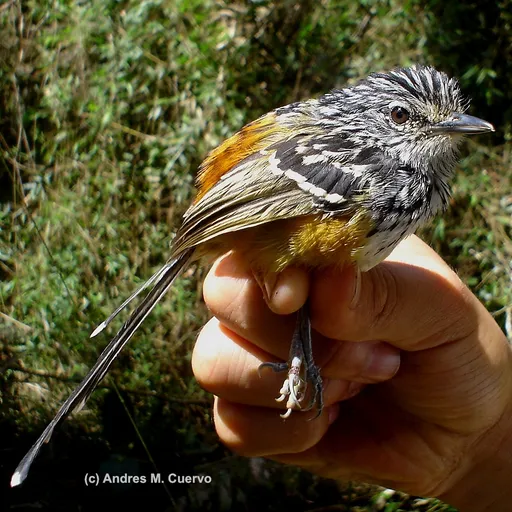
Streak-headed Antbird
Drymophila striaticeps
Least Concern
Listen
XC248526 · Niels Krabbe · Pichincha: turnoff to Mindo, Ecuador · CC BY-SA 4.0
Overview
The streak-headed antbird (Drymophila striaticeps) is a species of bird in the family Thamnophilidae, commonly known as the typical antbirds. It is found in the Andean regions of Bolivia, Colombia, Ecuador, and Peru.
Identification
- 14.5 to 15.5 cm long and weighing 11 to 13 g, with sexual dimorphism in plumage.
- Adult males have a black crown and back with white streaks, a white interscapular patch, a deep rufous rump, and a white face and breast with heavy black streaks.
- Females share the male's pattern but feature cinnamon-rufous and black crown streaks, lack the white interscapular patch, and have rufous-buff tones on the underparts instead of white.
- Male song is described as a loud 'tchip! tchip! djzzew-djzzew-djzzed-djzew', often answered by a female's descending 'tchip tchip tew-tew-tew'.
Habitat
This bird inhabits the understorey to mid-storey of montane evergreen and secondary forests, with a strong preference for bamboo thickets. Its distribution is disjunct across the Colombian, Ecuadorian, and Peruvian Andes, extending into Bolivia's La Paz Department, at elevations ranging from 1,200 to 3,150 m.
Diet
It feeds primarily on insects and probably spiders, foraging in bamboo thickets between 1 and 15 m above the ground. It captures prey by reaching or lunging from perches and making short sallies, typically operating alone, in pairs, in family groups, or occasionally in mixed-species flocks.
Did you know?
Despite the name 'antbird', this species is not known to follow army ants, distinguishing its foraging behaviour from other members of the family. Its ability to utilise second-growth habitats may render it less vulnerable than other members of its genus.
Sources
- Wikipedia · CC BY-SA 4.0
- Wikidata · CC0 1.0