
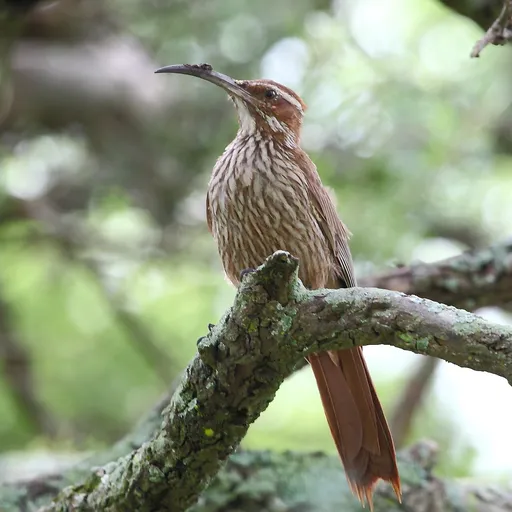
Scimitar-billed Woodcreeper
Drymornis bridgesii
Least Concern
Overview
The scimitar-billed woodcreeper is a species of ovenbird in the family Furnariidae, found in parts of South America. It is a large woodcreeper that is unique among its relatives for foraging primarily on the ground rather than on tree trunks.
Identification
- Adults have dark rufous ear coverts with a white supercilium and moustachial stripe, while the forehead, crown, and nape are rufous to dark brown.
- The bird features a long, decurved bill and measures 26 to 35 cm in length, with a relatively short tail.
- Underparts are reddish brown with bold white streaks that narrow through the belly, bordered by dark brown edges.
- Song includes a downslurred, decelerating series of upslurred whistled notes described as "tweedle tweedle tweed twee twee".
Habitat
This species inhabits the Gran Chaco, Pampas, and Argentine Espinal ecoregions, occurring in woodlands, scrublands, thorn forests, and savannas across extreme southeastern Bolivia, western Paraguay, the Brazilian state of Rio Grande do Sul, Uruguay, and north-central Argentina. It also uses abandoned pastures and fragmentary woodlands in agricultural areas, typically reaching elevations of only 500 m, though it goes up to 1,350 m in parts of Argentina.
Diet
It consumes a varied diet of arthropods, invertebrates such as snails, and vertebrates including frogs, snakes, lizards, and nestling birds, as well as reptile and bird eggs. The bird forages mainly on the ground but also uses trees and cacti, capturing prey by probing into the ground, bromeliads, and holes, or by grabbing items from the ground surface. It typically forages singly or in pairs, though occasionally in small mixed-species groups.
Did you know?
The scimitar-billed woodcreeper is unique among woodcreepers because it forages mainly on the ground, unlike its relatives which typically climb tree trunks. It is also a monotypic genus, meaning it is the only member of Drymornis bridgesii.
Sources
- Wikipedia · CC BY-SA 4.0
- Wikidata · CC0 1.0