
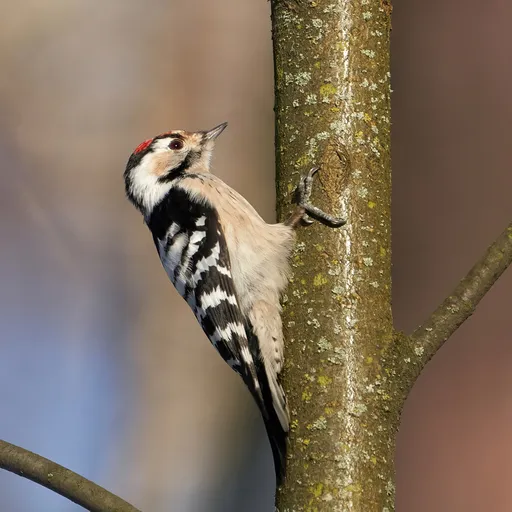
Lesser Spotted Woodpecker
Dryobates minor
Least Concern
Listen
XC1042761 · Sonothèque ADVL · Jullouville, Manche, Normandie, France · CC0 1.0
Overview
The lesser spotted woodpecker (Dryobates minor) is the smallest woodpecker in Europe, characterised by its compact size and preference for the tops of tall trees. It has recently been reclassified from the genus Dendrocopos to Dryobates based on molecular phylogenetic evidence.
Identification
- A small bird, measuring 14 to 16.5 cm in length, with slate-grey bill and legs.
- Males display a crimson crown, a brown forehead, and black stripes across the eye and from the bill to the neck.
- Females have a white crown, while young birds of both sexes retain some crimson on the head.
- Features broad, conspicuous barring on the wings and narrower bars across the lower back and outer tail feathers.
- Produces a loud, repeated 'keek' call and a vibrating rattle that can be distinguished from larger species with experience.
Habitat
Found throughout the Palearctic region, this species inhabits woods and parks, typically spending most of its time in the tops of tall trees. Populations are mostly resident, though they can exhibit some nomadic tendencies, and are currently listed as Least Concern on the IUCN Red List.
Diet
Forages for insects similar to the great spotted woodpecker, chipping away at rotten wood to find larvae and using litter at the base of trees to locate infestations in upper branches. During the breeding season, it increases its intake of surface-living insects such as aphids from the foliage and bark, while roosting in old holes at night.
Did you know?
Despite its small size, the bird can excavate nesting holes up to 20 m high, leaving a distinctive litter of wood chips that often serves as the first sign of its presence. Its population in the UK has been sensitive to habitat management, with numbers nearly halving between 2009 and 2017 due to the removal of dead trees.
Sources
- Wikipedia · CC BY-SA 4.0
- Wikidata · CC0 1.0