
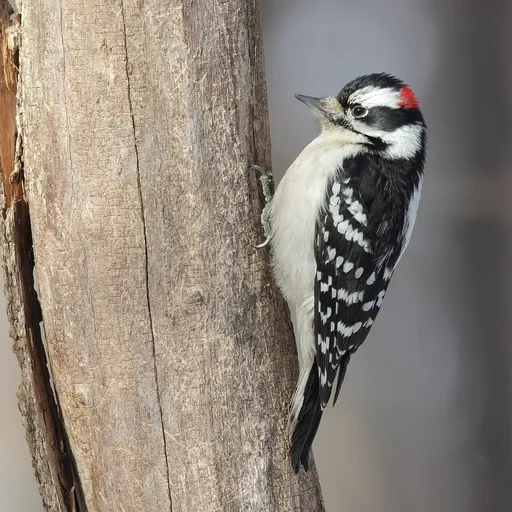
Downy Woodpecker
Dryobates pubescens
Least Concern
Listen
XC320358 · Jonathon Jongsma · Bancroft Neighborhood, Minneapolis, Hennepin County, Minnesota, United States · CC BY-SA 4.0
Overview
The downy woodpecker (Dryobates pubescens) is the smallest woodpecker species in North America, ranging in length from 14 to 18 cm. Despite its resemblance to the larger hairy woodpecker, it is not closely related, with the similarity resulting from convergent evolution.
Identification
- Primarily black on the upperparts and wings, with a white back, throat, and belly featuring white spotting.
- Bill is shorter than the head, distinguishing it from the hairy woodpecker whose bill is approximately equal to head length.
- Black tail with white outer feathers that are barred with black; the downy woodpecker has black spots on its white tail feathers, unlike the hairy woodpecker.
- Adult males have a red patch on the back of the head, while juvenile males display a red cap.
Habitat
Native to forested areas, mainly deciduous, throughout the United States and Canada, excluding the deserts of the southwest and the tundra of the north. These birds primarily reside in forests but may migrate south or to lower elevations in winter. Nesting sites are positively correlated with the presence of dead trees, as they excavate cavities in softer heartwood for protection.
Diet
Feeds primarily on insects, supplemented by seeds and berries, foraging on trees by picking bark surfaces in summer and digging deeper in winter. They are a natural predator of the European corn borer and can often be found in suburban backyards in winter, feeding on suet and shelled peanuts from birdfeeders.
Did you know?
The downy and hairy woodpeckers are not closely related despite their near-identical appearance, a case of convergent evolution that remains unexplained but may relate to their use of different food sizes to reduce competition.
Sources
- Wikipedia · CC BY-SA 4.0
- Wikidata · CC0 1.0