
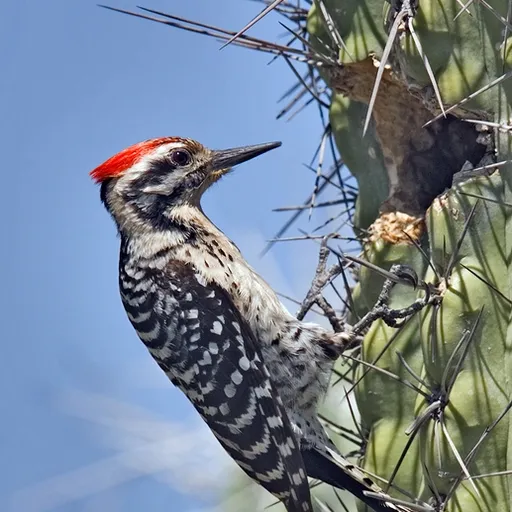
Ladder-backed Woodpecker
Dryobates scalaris
Least Concern
Listen
XC891587 · steve · Frontera Audubon Society (near Weslaco), Hidalgo County, Texas, United States · CC BY-SA 4.0
Overview
The ladder-backed woodpecker (Dryobates scalaris) is a small North American woodpecker classified as Least Concern on the IUCN Red List. It is fairly common in dry brushy areas and thickets across a large range spanning from the southwestern United States to Nicaragua.
Identification
- Small size, measuring approximately 16.5 to 19 cm in length.
- Primarily black and white plumage featuring a barred pattern on the back and wings resembling ladder rungs.
- Cream-colored underparts on the breast and flanks speckled with black, with a speckled rump.
- Adult males possess a red crown patch, which is smaller in immatures and absent in females.
- Southern populations exhibit duskier buff breasts and distinctly smaller bills.
Habitat
The species inhabits dry brushy areas and thickets where it is fairly common. Its range includes the southwestern United States, extending north to extreme southern Nevada and southeastern Colorado, most of Mexico, and locally in Central America as far south as Nicaragua.
Diet
Like most woodpeckers, it bores into tree trunks with its chisel-like bill to hunt for insects and their larvae. It also feeds on fruit produced by cacti.
Did you know?
In more arid environments, the bird will excavate nesting cavities in large cacti rather than tree trunks. The female lays between two and seven plain white eggs, which are incubated by both sexes.
Sources
- Wikipedia · CC BY-SA 4.0
- Wikidata · CC0 1.0