
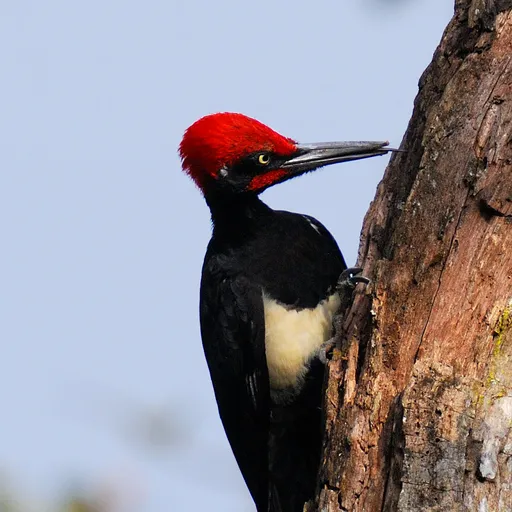
White-bellied Woodpecker
Dryocopus javensis
Least Concern
Overview
The white-bellied woodpecker, also known as the great black woodpecker, is one of the largest living species of woodpecker found in the Asian region. It inhabits evergreen forests across the tropical Indian subcontinent and Southeast Asia and is classified as Least Concern by the IUCN, although many island subspecies are endangered or extinct.
Identification
- Adults measure between 40 and 48 cm in length with a body mass ranging from 197 to 350 g, making them comparable in size to the North American pileated woodpecker.
- The plumage is primarily black, with populations differing in the distribution and extent of white markings; some forms feature whitish underwing coverts and a white rump, while the face generally lacks white.
- The bill is notably long, measuring between 4.6 and 6 cm, suitable for extracting prey from under bark.
- Vocalisations include loud drumming, particularly in the breeding season, and a range of calls from short, sharp kuk sounds to intoned kyuk and kee-yow notes.
Habitat
This species resides in evergreen forests throughout the tropical Indian subcontinent and Southeast Asia. It typically nests in large dead trees, frequently located beside rivers or in open forest areas, and can be found near well-used tracks despite being a shy bird.
Diet
The bird feeds mainly on insects such as ants or grubs obtained from under bark, though it occasionally consumes fruit. Solitary adults may spend an hour foraging at a single suitable tree, and they are usually observed singly or in pairs, sometimes with a third bird.
Did you know?
The subspecies D. j. hodgsonii in India is known to breed from January to May and often reuses the same large dead tree for nesting year after year. In the Bastar region of central India, these birds have become rare due to local tribes seeking their squabs.
Sources
- Wikipedia · CC BY-SA 4.0
- Wikidata · CC0 1.0