
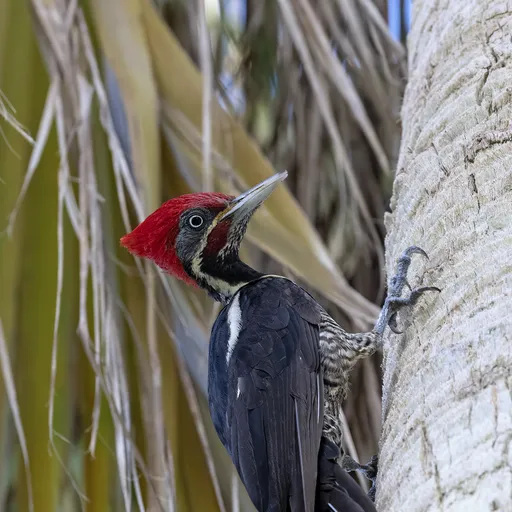
Lineated Woodpecker
Dryocopus lineatus
Listen
XC250796 · Niels Krabbe · Napo: Mushullakta, Ecuador · CC BY-SA 4.0
Overview
The lineated woodpecker, or Dryocopus lineatus, is a very large woodpecker that serves as a resident breeding bird across a vast range extending from southern Mexico to northern Argentina and Trinidad. It closely resembles the pileated woodpecker found in North America.
Identification
- Length of 31.5 to 36 cm with predominantly black upperparts and a red crest.
- Whitish lines extending from the base of the bill down the neck and shoulders, though often reduced or absent in southern populations.
- Whitish underparts heavily barred with black, with white visible on the wings during flight.
- Adult males feature a red malar line and red forehead, whereas these markings are black in adult females.
- The call is a loud, ringing wic-wic-wic.
Habitat
This species inhabits forest borders and other open woodland areas. It is generally not a mountain bird, though it has been occasionally recorded in upland regions such as the Serranía de las Quinchas in Colombia.
Diet
Lineated woodpeckers chip out large holes in trees to search for insects, primarily consuming ants and their larvae, beetles and their larvae, termites, orthopterans, and caterpillars. They also supplement their diet with seeds from Heliconia and Clusia rosea, as well as fruits, berries, and nuts.
Did you know?
Both sexes participate in excavating nest cavities in dead trees, which can be situated at variable heights from 2 to 27 m above the ground. During incubation, males and females take 2- to 3-hour shifts during the day, but only the male incubates at night.