
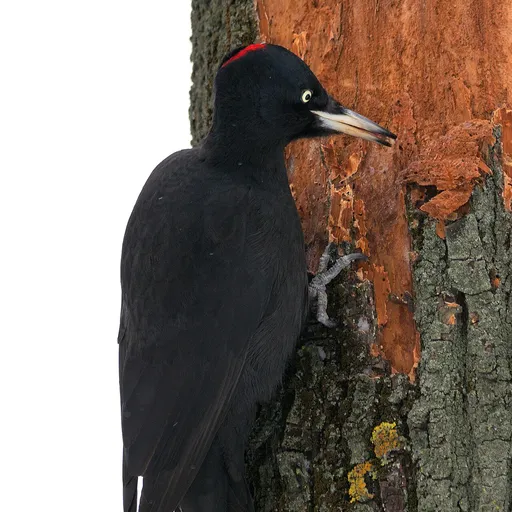
Black Woodpecker
Dryocopus martius
Least Concern
Listen
XC815494 · Sonothèque ADVL · La Lucerne-d'Outremer, Manche, Normandie, France · CC0 1.0
Overview
The black woodpecker (Dryocopus martius) is a large, non-migratory woodpecker species that inhabits mature forests across the northern Palearctic. It is the largest woodpecker in Europe and one of the largest in the world, serving as a keystone species by creating cavities that support numerous other bird and mammal species.
Identification
- Entirely black plumage with a distinct red crown; males have a completely red crown, while females have red only on the hindcrown.
- Large size measuring 45 to 55 cm in length, with piercing yellow eyes.
- Very long bill and short, stumpy legs with sharp claws.
- Flight is characterised by slow, unsteady-seeming wing beats with the head raised, rather than the typical dipping, bounding pattern of other woodpeckers.
- Vocalisations include a short, loud, whistling kree-kree-kree call and a screech-like shrill while in flight.
Habitat
The species prefers extensive, mature woodland, including coniferous, tropical, subtropical, and boreal forests, where it resides in large excavated tree holes. Its range spans from Spain across most of Europe and into parts of Asia, including Korea, Japan, China, Iran, and Kazakhstan, though it is absent from the British Isles.
Diet
The bird feeds primarily on carpenter ants and wood-boring beetle grubs, which it digs out of dead trees using its large, powerful bill. It possesses specially adapted neck muscles that allow it to hack away at tree bark endlessly.
Did you know?
The black woodpecker is considered a "keystone" species because its large nest excavations provide essential secondary housing for many other birds and mammals after they are no longer needed by the woodpeckers.
Sources
- Wikipedia · CC BY-SA 4.0
- Wikidata · CC0 1.0