
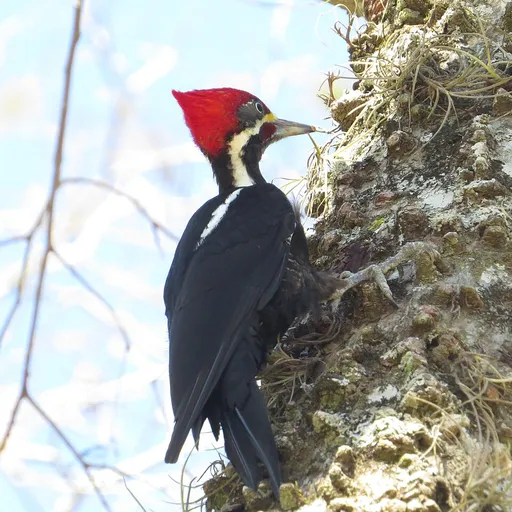
Black-bodied Woodpecker
Dryocopus schulzii
Overview
The black-bodied woodpecker (Dryocopus schulzii) is a Near Threatened species within the woodpecker family, found in southern South America. It is monotypic, though its taxonomy is unsettled with some authorities placing it in the genus Hylatomus or spelling the specific epithet as schulzi.
Identification
- Length of 29 to 30 cm with a long, pointed crest.
- Adult males feature a red forehead and crest, whereas females have a blackish lower forehead and a black malar stripe.
- Predominantly black below the neck with a long, pale ivory-white chisel-shaped bill and dark gray legs.
- Emits a loud "wic wic wic wic wic" call, a harsh rattle, and performs long drumming rolls.
Habitat
The species inhabits the woodlands and savannas of the dry Gran Chaco and transition zones to moister montane forests at elevations up to 1,000 m. Its range extends from the southern Bolivian departments of Santa Cruz and Tarija south through western and central Paraguay into north-central Argentina, as far as Córdoba and San Luis provinces.
Diet
The bird forages singly, in pairs, or in small family groups by pecking, hammering, and probing trunks and main limbs. The specific composition of its diet has not been described.
Did you know?
The bird excavates its nest hole in dead trees or utility poles, though details regarding clutch size and parental care remain unknown.