
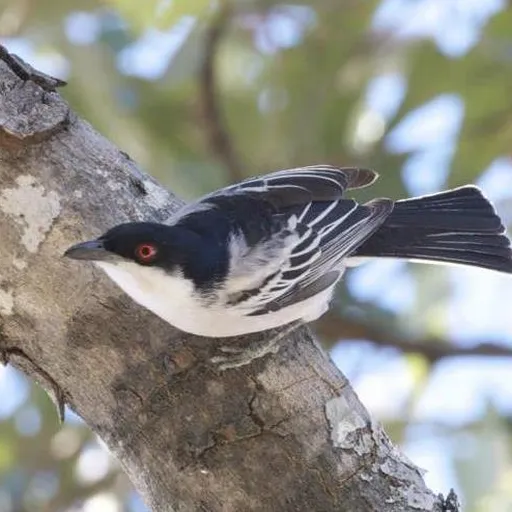
Black-backed Puffback
Dryoscopus cubla
Least Concern
Listen
XC1068358 · Louis A. Hansen · Arabuko-Sokoke, T-junction at Elephant road, Kenya · CC BY 4.0
Overview
The black-backed puffback (Dryoscopus cubla) is a sedentary bushshrike found in various wooded habitats across sub-Saharan Africa south of the equator. Classified as Least Concern on the IUCN Red List, it is the only puffback species present in much of its range, from southern Somalia to coastal South Africa.
Identification
- Males feature deep blue-black upperparts with a black cap over a red eye, contrasting with pure white underparts.
- Females display black loral stripes, white supraloral feathering, and paler ear coverts with greyer backs than males.
- Approximately 17 cm in length, with brownish bills and brown irises in immature birds that resemble females but have greyer upperparts.
- Distinguishing sounds include a varied repertoire of whistling, clicking and rasping noises, such as chow-chow-chow or tik-weeu calls during display.
Habitat
This species inhabits gardens, riparian thickets, mangroves, woodlands, moist or arid savanna, bushveld and fringes of afromontane forest from sea level to 2,200 m a.s.l. Highest reporting rates occur in dense woodlands such as miombo, gusu, mopane, and riparian fringing forests, including the Okavango Delta. It naturally avoids arid Acacia scrub, treeless highveld, alpine regions, and the interior of afromontane forests in the Congo Basin.
Diet
The black-backed puffback feeds on large numbers of caterpillars, along with beetles, ants, termites and small fruit. It actively moves about the higher strata of trees, often in mixed-species flocks, to forage for its prey.
Did you know?
The specific name cubla, coined by François Levaillant, is derived from a native southern African name where the initial 'c' represents an onomatopoeic click sound. Males also perform a remarkable display by puffing out loose rump and lower back feathers to assume a ball-like appearance while calling loudly.
Sources
- Wikipedia · CC BY-SA 4.0
- Wikidata · CC0 1.0