
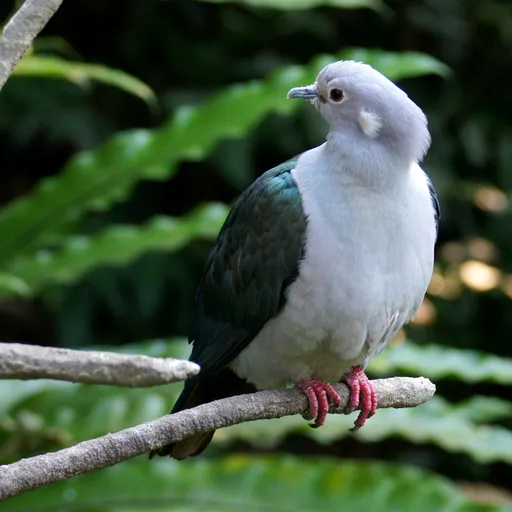
Green Imperial Pigeon
Ducula aenea
Near Threatened
Listen
XC1175247 · Untung Sarmawi · Loh Liang - Komodo National Park, Kabupaten Manggarai Barat, Nusa Tenggara Timur, Indonesia · CC BY 4.0
Overview
The green imperial pigeon (Ducula aenea) is a large forest pigeon classified as Near Threatened on the IUCN Red List. Its specific name is derived from the Latin word for bronze, reflecting its metallic plumage. This species has a vast range across tropical southern Asia and was first described by Brisson in 1760.
Identification
- Large, plump bird measuring 45 cm in length, with metallic green back, wings, and tail.
- White head and underparts, distinguished by maroon undertail coverts.
- Produces a deep and resonant call that often serves as the first indication of this treetop species.
- Flight is fast and direct, characterised by regular wing beats with occasional sharp flicks.
Habitat
This species inhabits forests across a wide range, extending from Nepal, southern India, and Sri Lanka eastwards to southern China, Indonesia, and the Philippines. It is a widespread resident breeding bird in these tropical southern Asian regions.
Diet
As an arboreal dove, the green imperial pigeon feeds on plant material found within the tree canopy.
Did you know?
Brisson's original description was based on a specimen he believed came from the Maluku Islands, but the species does not actually occur there, and the type locality was later designated as Flores in Indonesia. The species name aenea is derived from Latin for 'of a bronze colour' or 'coppery'.
Sources
- Wikipedia · CC BY-SA 4.0
- Wikidata · CC0 1.0