
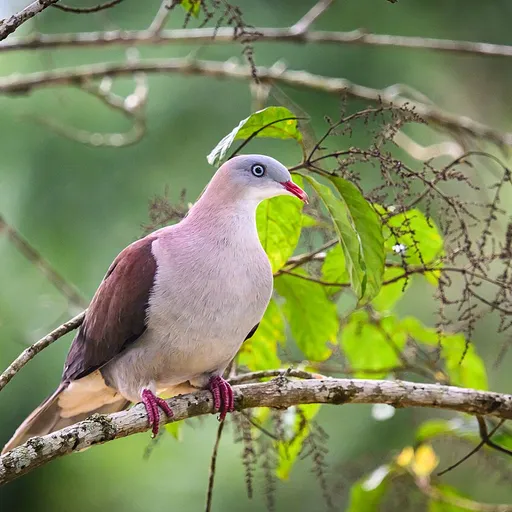
Mountain Imperial Pigeon
Ducula badia
Least Concern
Overview
The mountain imperial pigeon, also known as the maroon-backed or Hodgson's imperial pigeon, is a large species of bird in the pigeon and dove family with a wide range across southeastern Asia. It is classified as Least Concern on the IUCN Red List.
Identification
- 43–51 cm long, the largest pigeon in its range, with a fairly long tail, broad rounded wings, and slow wing-beats.
- Vinous-grey head, neck, and underparts with a contrasting white throat and brownish-maroon upperparts and wings; the upper body may appear duller.
- Slate-grey underwings and a blackish tail featuring a horizontal grey line.
- A deep, resonant boom that is only detectable at close range.
Habitat
Found in subtropical or tropical moist lowland forests, mangrove forests, and moist montane forests across Bangladesh, Bhutan, Brunei, Cambodia, China, India, Indonesia, Laos, Malaysia, Myanmar, Nepal, Thailand, and Vietnam. It inhabits elevations from sea level up to 2,550 m in the Himalayas and 2,200 m on Sumatra, preferring old-growth forests and generally breeding above 500 m.
Diet
Feeds on fruits and berries, particularly figs and nutmeg, which are plucked and swallowed whole. Occasionally descends to the ground to drink, as observed in Bornean mangroves, and may undertake partial altitudinal movement to pursue ideal feeding conditions.
Did you know?
Up to 200 or 300 of these pigeons can be flushed at once in Bornean mangroves, though they are usually solitary and difficult to spot as they remain high in the canopy.
Sources
- Wikipedia · CC BY-SA 4.0
- Wikidata · CC0 1.0