
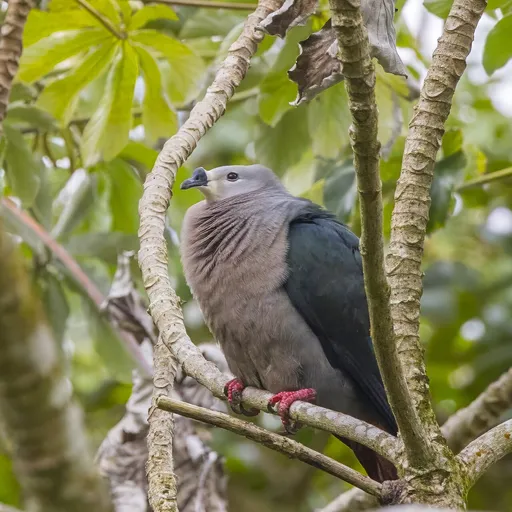
Pacific Imperial Pigeon
Ducula pacifica
Least Concern
Overview
The Pacific imperial pigeon, also known as the Pacific pigeon or lupe, is a widespread species in the family Columbidae. It is classified as Least Concern by the IUCN Red List, although it has suffered local declines due to habitat loss and hunting.
Identification
- Measuring 36–41 cm in length, the bird features blackish-green wings, tail and back, with a light grey head and neck.
- The breast is grey with a pinkish tinge, while the undertail coverts are brown; females are slightly smaller than males.
- The bill is black with a distinct knob on the upper mantle, which juveniles lack, along with the pink breast coloration.
- The iris is red.
Habitat
Found across numerous Pacific islands including American Samoa, the Cook Islands, Fiji, and others, this species inhabits tropical moist lowland forests on smaller islands and tropical moist montane forests on larger islands.
Diet
Primarily frugivorous, the species consumes fruit from various plant species and occasionally leaves and flowers. It acts as an important seed disperser as the seeds of its food are not digested or damaged.
Did you know?
In Niue, the Pacific imperial pigeon is known as a Lupe and was historically hunted using elaborate traps on stone platforms, though the origins of these birds remain unknown as no nests have ever been found on the island.
Sources
- Wikipedia · CC BY-SA 4.0
- Wikidata · CC0 1.0