
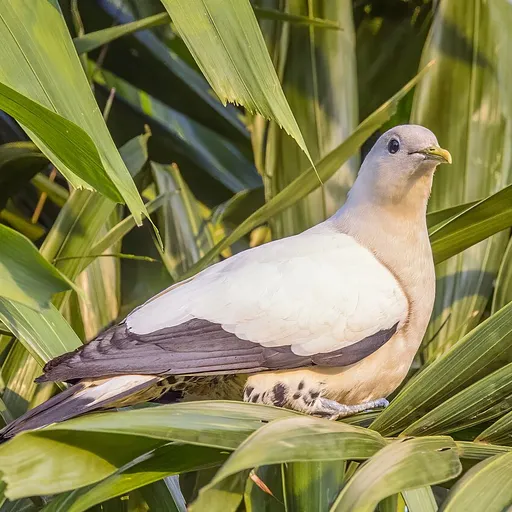
Torresian Imperial Pigeon
Ducula spilorrhoa
Least Concern
Overview
The Torresian imperial pigeon (Ducula spilorrhoa), also known as the nutmeg pigeon, is a relatively large, pied species of pigeon found in forest, woodland, and mangrove habitats across northern Australia and New Guinea. It is currently classified as Least Concern by the IUCN.
Identification
- A large, plump pigeon measuring 38–44 cm in length with a 45 cm wingspan.
- Entirely white or pale cream plumage, contrasting with black flight feathers, part of the tail, and spots on the undertail coverts.
- The head often appears brown due to soiling from eating fruit.
- Vocalisations include a deep "mrrrooooo", "roo-ca-hoo", and "up-ooooo".
Habitat
This species inhabits forests, woodlands, savannas, mangroves, and scrub in northern Australia, including the Torres Strait Islands, as well as New Guinea and nearby island groups. Most populations are resident, though Queensland birds migrate to New Guinea between February and April and return in July or August.
Diet
As an arboreal dove, it feeds almost exclusively on fruit, capable of swallowing large seeds which are later regurgitated or excreted whole after the pulp is digested. In north-east Queensland, flocks migrate daily from offshore islands to mainland rainforests to feed on fruit before returning at dusk.
Did you know?
Once present in massive colonies in Cairns, with Edmund Banfield noting in 1908 that 'fully 100,000 come and go evening and morning' in Dunk Island, the species was subjected to mass slaughter in the 19th and early 20th centuries, leading to a population that is now slowly recovering to an estimated 500,000 in Australia.
Sources
- Wikipedia · CC BY-SA 4.0
- Wikidata · CC0 1.0