
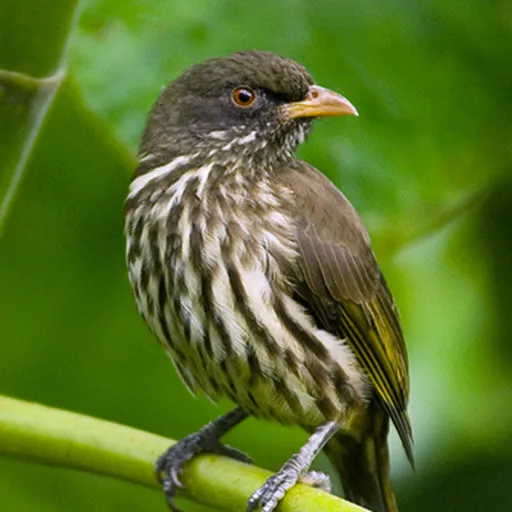
Palmchat
Dulus dominicus
Least Concern
Overview
The Dulus dominicus is a medium-sized passerine bird endemic to the Caribbean island of Hispaniola and the adjacent Saona and Gonâve Islands. It is the sole representative of its own family, Dulidae, and is closely related to waxwings and silky-flycatchers. This species is highly associated with palm trees, where it feeds, roosts, and nests.
Identification
- Medium-sized passerine, approximately 18–20 cm long, with a moderately odd appearance featuring small heads, short yet deeply-curved yellow-horn bills, and long necks.
- Plumage is olive-brown above and heavily streaked with brown below, with dark greenish-olive rumps and brown tails; primary feathers are yellow-green.
- Large, strongly-clawed feet and long, rounded wings; adults show no sexual dimorphism in plumage, though males have slightly larger wings.
- Immature birds resemble adults but possess darker throats and forenecks, as well as buff-coloured rumps.
Habitat
Endemic to Hispaniola (Haiti and the Dominican Republic) and the nearby Saona and Gonâve Islands, where it is common and widespread from sea level to 1,800 m. It inhabits a wide variety of environments, most commonly open savannas with royal palms, but also semi-open areas, broadleaf and pine forests, and human-modified habitats such as farmland, city parks, and gardens. The species avoids the highest mountains and dense closed forests, and is not migratory.
Diet
Primarily frugivorous, feeding on fruit and berries, particularly from royal palms and other species like the gumbo-limbo, though it also consumes leaves, flowers, and occasionally insects. Food is almost exclusively obtained from trees, with insects either gleaned from foliage or taken on the wing. It does not forage on the ground.
Did you know?
The palmchat constructs large, conspicuous communal nests of twigs that can reach up to 2 m across, with individual pairs maintaining separate chambers and entrances within the shared structure. These nests often house four to ten pairs, though records exist of nests containing up to 50 pairs, and are sometimes adopted by other bird species such as the mourning dove and white-necked crow.
Sources
- Wikipedia · CC BY-SA 4.0
- Wikidata · CC0 1.0