
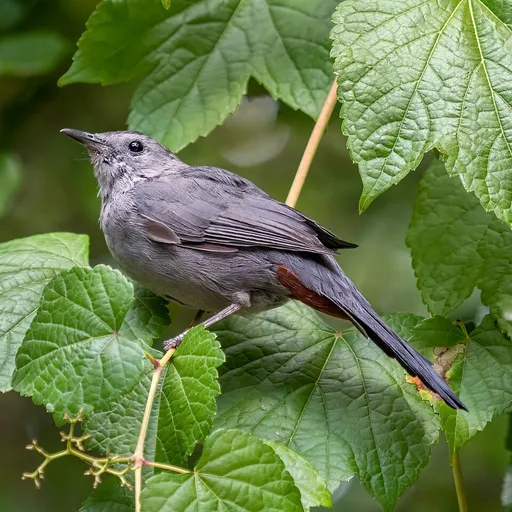
Grey Catbird
Dumetella carolinensis
Least Concern
Listen
XC819785 · Anonymous · West Point, Orange County, New York, United States · CC0 1.0
Overview
The grey catbird (Dumetella carolinensis) is a medium-sized perching bird belonging to the mimid family, native to most of temperate North America east of the Rocky Mountains. It is the only member of the genus Dumetella and serves as a basal lineage within the family, with no recognized subspecies.
Identification
- Adults are plain lead grey overall, with a slightly darker crown, blackish slim bill, eyes, legs, and feet, and rusty-colored undertail coverts.
- Flight reveals black wings and tail, some feathers with white borders, while juveniles appear plainer with buffy undertail coverts.
- Distinctive vocalizations include a cat-like call and a raspy song that is less musical than mockingbirds, usually singing phrases only once.
- The bird is reclusive, often singing from inside bushes or small trees where it is obscured by foliage.
Habitat
Prefers dense vegetative substrates, especially with thorny vegetation, such as scrublands, woodland edges, and overgrown farmland, while avoiding dense unbroken woodlands and coniferous forests. In winter, it shows an affinity for berry-rich thickets near water sources. The species migrates between temperate North American breeding grounds and winter quarters in the southeastern United States, Mexico, Central America, and the Caribbean.
Diet
An omnivore that eats approximately 50% fruit and berries, alongside arthropods such as ants, beetles, grasshoppers, and caterpillars. They forage primarily on the ground in leaf litter, as well as in shrubs and trees, often pecking more fruit than they can consume. They also peck the eggs of other bird species, including brown-headed cowbirds, to remove them from nests.
Did you know?
The species' scientific name, Dumetella carolinensis, is derived from the Latin dūmus meaning 'thorny thicket', reflecting its habit of singing while hidden in undergrowth, and carolinensis for 'from the Carolinas', the region where it was first identified.
Sources
- Wikipedia · CC BY-SA 4.0
- Wikidata · CC0 1.0