
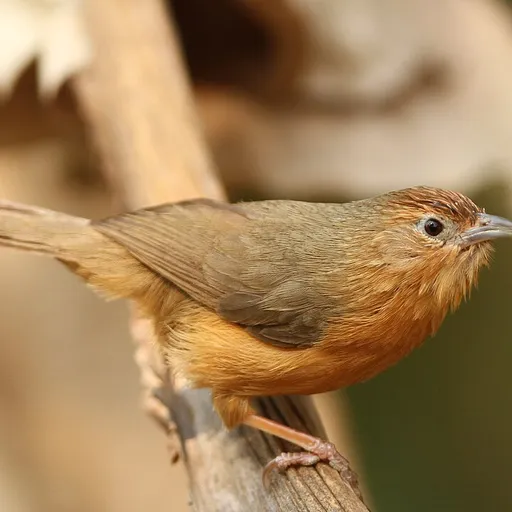
Tawny-bellied Babbler
Dumetia hyperythra
Least Concern
Overview
The tawny-bellied babbler (Dumetia hyperythra), previously known as the rufous-bellied babbler, is a small passerine in the Old World babbler family. It comprises three subspecies within the Indian subcontinent and is classified as Least Concern by the IUCN.
Identification
- A small bird measuring 13 cm including a long, round-tipped tail with outer feathers about half the length of the central feather.
- Dark brown above and orange-buff below, featuring a rufous grey crown and stiff forehead feathers.
- Adults in peninsular India and Sri Lanka possess a white throat, whereas the nominate subspecies in northern and eastern India has uniformly brown underparts.
- The Sri Lankan population (Dumetia hyperythra phillipsi) is distinguished by paler underparts and a larger, heavier bill.
Habitat
Found across Nepal, north-central India, and Sri Lanka, the species inhabits low scrub forests and tall grasslands. In Sri Lanka, it ranges up to approximately 1500 m above sea level. Populations within India are intergrading, with no disjunct distributions recorded.
Diet
This bird forages in small groups and feeds mainly on insects, but also consumes nectar from Bombax and Erythrina flowers. It is known to forage under dense shrubbery in a manner that has drawn comparison to pig behaviour.
Did you know?
In the Telugu language, the bird is called Pandi Jitta, literally meaning 'pig bird', due to its habit of foraging under dense shrubbery in a manner resembling that of pigs. Additionally, banded bay cuckoos are known to lay their eggs in the nests of tawny-bellied babblers.
Sources
- Wikipedia · CC BY-SA 4.0
- Wikidata · CC0 1.0