
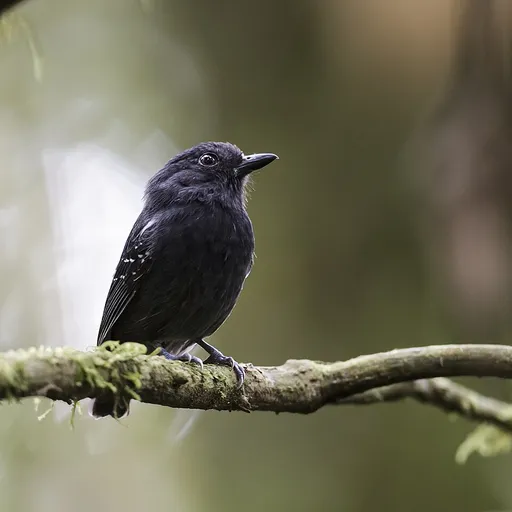
White-streaked Antvireo
Dysithamnus leucostictus
Least Concern
Listen
XC248612 · Niels Krabbe · Napo: 13 km SE San Rafael, Ecuador · CC BY-SA 4.0
Overview
The white-streaked antvireo, also known as the white-spotted antvireo, is a species of bird in the subfamily Thamnophilinae of the family Thamnophilidae, commonly referred to as typical antbirds. It is classified as Least Concern by the IUCN Red List, though its population is believed to be decreasing due to habitat loss. The species comprises two subspecies that have widely separated ranges across South America.
Identification
- Males of the nominate subspecies are mostly dark gray with a hidden white patch between the scapulars, dark gray wings with white tips and edges on the coverts, and a breast that is a darker blackish gray than the upperparts.
- Females feature a reddish-brown crown, nape, upperparts, wings, and tail, with gray sides of the head, throat, and underparts that are marked by bold white streaks; their flanks and crissum have a brown tinge and no streaks.
- The nominate subspecies' song consists of a short, easily countable series of strong whistles with a falling pitch, transcribed as "wee WEE wee wee wee whew".
- Subspecies D. l. tucuyensis males display more white on their coverts, including at the wing bend and on outermost primaries, while females are paler with yellower upperparts and larger underpart streaks.
Habitat
This species inhabits the understorey of montane evergreen forest, typically between 900 and 1,800 m in Colombia and 1,350 and 1,850 m in Peru, with lower elevations in Venezuela and Suriname. Its range is split between the eastern slopes of the Andes in Colombia, Ecuador, and northern Peru, and the Venezuelan Coastal Ranges with a small population on a tepui in Suriname. It is considered restricted to little-disturbed primary forest and is uncommon in most of its range, though it can be locally common in Venezuela.
Diet
The diet consists mainly of insects and other arthropods, though specific details are not fully known. The bird typically forages in pairs or as part of a mixed-species feeding flock, feeding from live leaves, vines, and twigs by gleaning or jumping up from a perch. It generally operates 1.5 to 4 m above the ground but frequently drops to the ground to capture prey.
Did you know?
The specific name leucostictus is derived from Ancient Greek, meaning 'white' and 'spotted', reflecting the bird's distinctive plumage. Although the species was once thought to be a year-round resident throughout its range, this assumption applies to the closely related plumbeous antvireo, not necessarily the white-streaked antvireo.
Sources
- Wikipedia · CC BY-SA 4.0
- Wikidata · CC0 1.0