
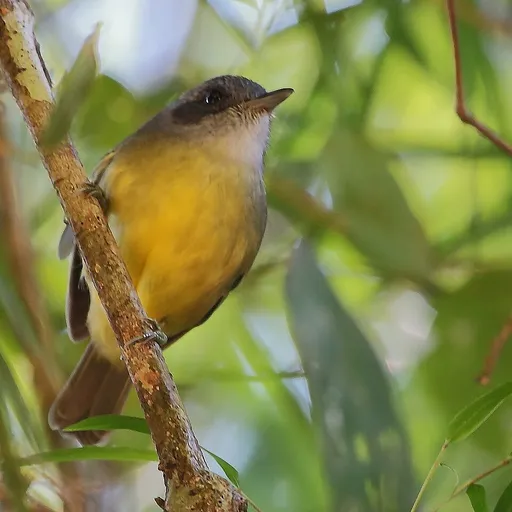
Plain Antvireo
Dysithamnus mentalis
Least Concern
Listen
XC249405 · Niels Krabbe · Napo: km 3 Narupa-Loreto road, Ecuador · CC BY-SA 4.0
Overview
The plain antvireo (Dysithamnus mentalis) is a passerine bird in the family Thamnophilidae, commonly known as the typical antbirds. It possesses an extremely large range across Mexico, Central America, the Caribbean, and South America, though its distribution is oddly shaped and disjunct. Classified as Least Concern by the IUCN, it is generally a year-round resident throughout its territory.
Identification
- A chunky bird measuring 10 to 13 cm in length, featuring a large head and short tail.
- Adult males of the nominate subspecies have a dark grey forehead and crown with blackish ear coverts, greyish-olive upperparts, and a hidden white patch between the scapulars.
- Males display dark greyish-olive wings with olive edges on flight feathers and white tips on greater coverts; their underparts are white with light grey spots on the throat and upper breast, fading to pale grey flanks and a yellow belly center.
- Song consists of a short series starting with evenly paced notes that become abrupt and drop in pitch, often described as a high nasal rattle or a barking series.
Habitat
The species inhabits a variety of landscapes, including humid montane evergreen forest, mature secondary forest, and dry savanna forest, depending on the region. Its range spans Mexico, most of Central America (excluding El Salvador), Trinidad and Tobago, and most of South America, with specific exceptions such as Chile and Uruguay. Elevations vary widely, from sea level in some areas to as high as 2,500 m in mountainous regions of Costa Rica and Bolivia.
Diet
This bird feeds mostly on insects, supplemented by other arthropods like spiders and occasionally Rapanea mistletoe berries. It typically forages singly or in pairs, and often joins mixed-species feeding flocks, though it may also forage away from them. It gleans sluggishly from perches in foliage, vines, and thin branches, usually near the ground to 4 or 5 m above, though it occasionally attends army ant swarms.
Did you know?
Breeding pairs in the Atlantic Forest are highly territorial, defending patches of habitat that can be as large as 7,000 m², although sometimes the defended area is only half that size. The nest is a cup made of fibers from roots, fungus, and green plants, often covered with green moss and suspended from a branch fork between 0.6 and 2.5 m above the ground.
Sources
- Wikipedia · CC BY-SA 4.0
- Wikidata · CC0 1.0