
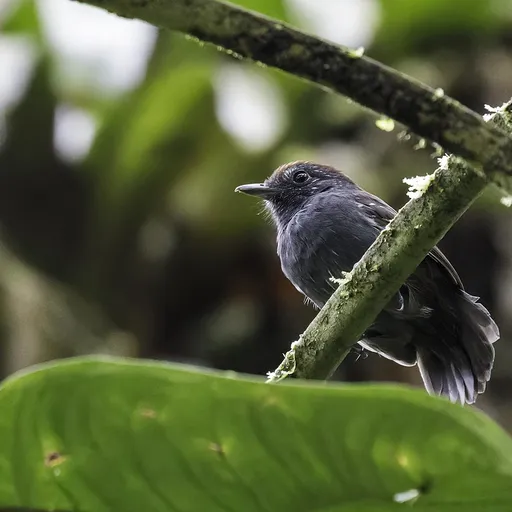
Bicolored Antvireo
Dysithamnus occidentalis
Near Threatened
Overview
The bicolored antvireo, Dysithamnus occidentalis, is a Near Threatened insectivorous bird within the family of typical antbirds. It is a small, poorly known species that inhabits the humid montane forests of the Andes in South America.
Identification
- Males of the nominate subspecies have a blackish gray head and upperparts with a mostly hidden white patch between the scapulars, while wings are black with white dots on the coverts.
- Females feature a chestnut crown and upperparts with buffy white spots on the wing coverts, contrasting with a dark grey face and streaked throat.
- The species is approximately 13 to 13.5 cm long and exhibits paler plumage in the punctitectus subspecies.
- Vocalisations include a fast, throaty scold described as 'jeér-deer-dur', clear 'peeu' calls, and accelerating, descending series of rising whistles in Peru.
Habitat
This species is found on the Pacific and eastern slopes of the Andes, spanning Colombia, Ecuador, and Peru. It primarily occupies the understorey of humid montane evergreen forest, favouring natural openings created by treefall or landslides at elevations between 1,500 and 2,500 m.
Diet
The diet is not fully documented but consists mostly of insects and other arthropods. Foraging is typically done singly or in pairs rather than in mixed-species flocks, involving gleaning from leaves and twigs or sallies from a perch within two metres of the ground.
Did you know?
The only recorded nest was an open cup constructed from fungal fibers and twigs, observed in Ecuador during December. At the time of discovery, it contained a single nestling being fed by both parents.
Sources
- Wikipedia · CC BY-SA 4.0
- Wikidata · CC0 1.0