
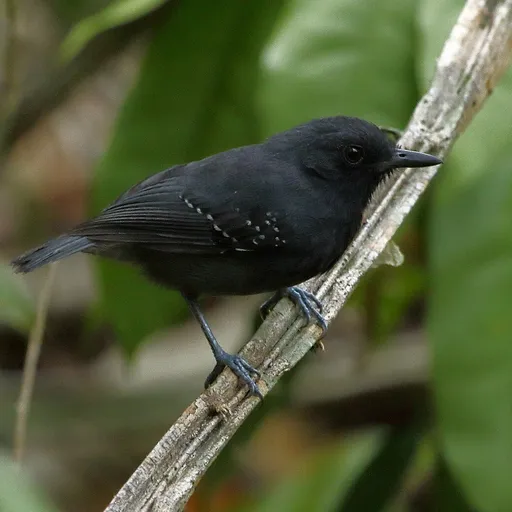
Plumbeous Antvireo
Dysithamnus plumbeus
Vulnerable
Overview
The plumbeous antvireo, Dysithamnus plumbeus, is a Vulnerable species of bird in the family Thamnophilidae, commonly known as the typical antbirds. This monotypic species is endemic to Brazil, where it has been recognised as a distinct entity since the early 2000s.
Identification
- Length of 12 to 13 cm (4.7 to 5.1 in) with dark gray head, upperparts, and tail in adult males, featuring a hidden white patch between the scapulars and black wings with white-tipped coverts.
- Adult females display an olive-brown head and upperparts with buff-white spots on the wing coverts, a very pale gray throat, and ochraceous belly and crissum.
- Song consists of a slow series of 6–8 evenly spaced, rising and falling, sad-sounding notes.
Habitat
Found locally in southeastern Brazil within the Atlantic Forest, this species inhabits the understory of evergreen forests. It mostly occurs below 600 m (2,000 ft) in elevation, though it can be found as high as 900 m (3,000 ft), favouring overgrown openings such as those created by fallen trees.
Diet
The plumbeous antvireo primarily consumes insects and other arthropods, foraging singly or in pairs and sometimes joining mixed-species feeding flocks. It typically feeds within about 2 m (7 ft) of the ground, often gleaned from live leaves, vines, and twigs while perched, though it also probes dead leaf clusters.
Did you know?
Only one nest has ever been documented for this species, which was located just 0.3 m (1 ft) above the ground in a small shrub and contained two eggs.
Sources
- Wikipedia · CC BY-SA 4.0
- Wikidata · CC0 1.0