
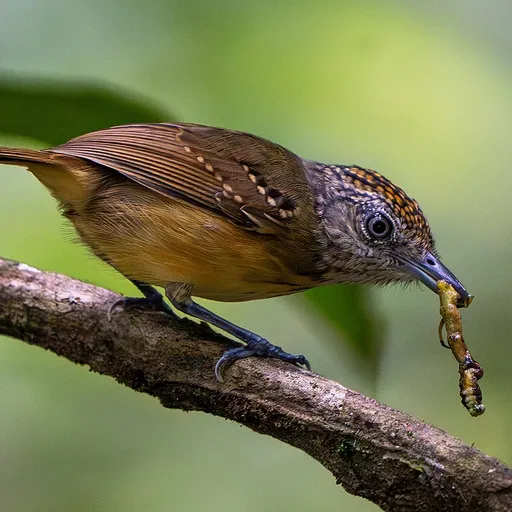
Spot-crowned Antvireo
Dysithamnus puncticeps
Least Concern
Listen
XC248194 · Niels Krabbe · Esmeraldas: 18.5 road km NNW Alto Tambo, Ecuador · CC BY-SA 4.0
Overview
The spot-crowned antvireo (Dysithamnus puncticeps) is a small bird in the subfamily Thamnophilinae of the family Thamnophilidae, known as the typical antbirds. It is a monotypic species found in parts of Central and South America. Although its population is believed to be decreasing, it is currently listed as Least Concern on the IUCN Red List.
Identification
- Measures 10 to 12 cm in length and weighs between 15 and 17 g.
- Adult males display a dark gray forehead, crown, and nape heavily marked with white spots, alongside grayish olive upperparts and a hidden white patch between the scapulars.
- Adult females differ by having a rufous crown and nape with dark spots, pale buff ear coverts, and wing coverts that are less black than those of the male.
- The song consists of a rapid trill that rises slightly in pitch, falls slightly at the end, and accelerates in pace, accompanied by a short descending 'chirr' call.
Habitat
This species inhabits the understorey to mid-storey of evergreen forests in lowland and foothill regions across Costa Rica, Panama, Colombia, and northwestern Ecuador. Its elevation range extends from sea level to 1,000 m in Colombia, while it occurs up to 800 m in Costa Rica and Ecuador and 500 m in Panama. It is a year-round resident throughout its range.
Diet
The spot-crowned antvireo feeds primarily on insects and other arthropods such as spiders. It typically forages in pairs, family groups, or mixed-species flocks, gleaning from live foliage between 3 and 8 m above the ground. The bird may also follow army ants for brief periods to snatch prey.
Did you know?
Despite being a species with an unknown population size that is believed to be decreasing, no immediate threats to its survival have been identified by the IUCN.
Sources
- Wikipedia · CC BY-SA 4.0
- Wikidata · CC0 1.0