
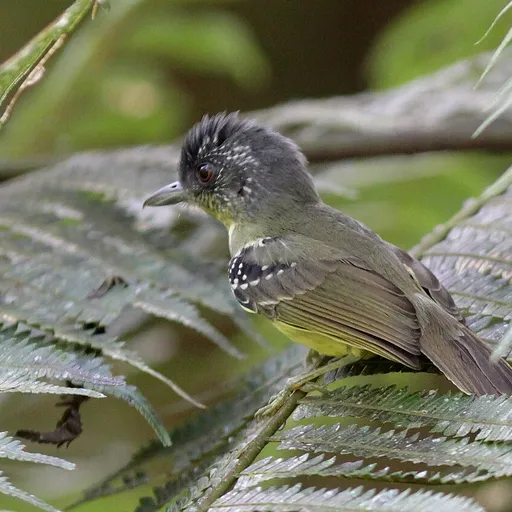
Spot-breasted Antvireo
Dysithamnus stictothorax
Least Concern
Overview
The spot-breasted antvireo (Dysithamnus stictothorax) is a Near Threatened species of bird in the family Thamnophilidae, the typical antbirds. It is endemic to coastal southeastern Brazil, where it inhabits the understorey and mid-storey of evergreen forests. The species is believed to be a year-round resident throughout its range.
Identification
- Adults are approximately 12 cm long, with males displaying a dark grey crown, blackish ear coverts, and white spots on the sides of the head.
- Males have a white throat and upper breast with large dark spots, while females possess a chestnut crown and fewer spots on the underparts.
- The song consists of a hurried series of about 20 mellow, slightly staccato rising and falling notes, with the last few notes accelerated.
- Calls include a short upslurred 'chirr', a nasal 'qwark', and a series of three notes where the first two are on the same pitch.
Habitat
The bird is found in coastal southeastern Brazil from southeastern Bahia south to Santa Catarina, extending somewhat inland into Minas Gerais. It inhabits the understorey to mid-storey of evergreen forest in lowland and lower montane regions, favouring forest edges such as those along roads and natural clearings. Its elevation range spans from sea level to 1,250 m.
Diet
The spot-breasted antvireo feeds mostly on insects and other arthropods, occasionally consuming Rapanea mistletoe berries. It usually forages singly or in pairs and often joins mixed-species feeding flocks, working from near the ground to about 10 m above it. Foraging is active and acrobatic, typically involving gleaning from live foliage and vines while perched, with occasional short sallies or jumps to catch prey.
Did you know?
Only one active nest of this species has been photographed, revealing a small cup suspended from a fork in a branch roughly 15 m above the ground. This scarcity of nest data contrasts with the fact that the species is considered fairly common in most of its range.
Sources
- Wikipedia · CC BY-SA 4.0
- Wikidata · CC0 1.0