
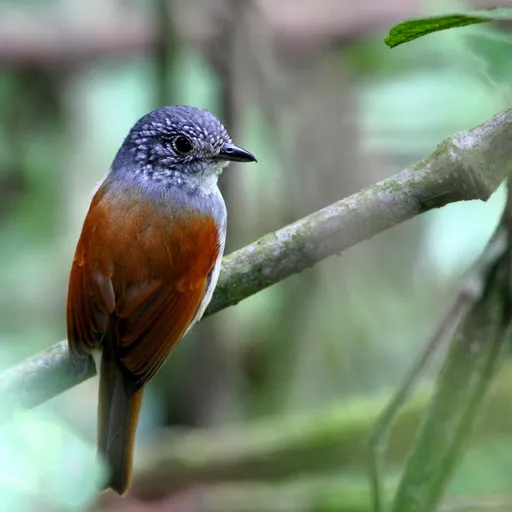
Rufous-backed Antvireo
Dysithamnus xanthopterus
Least Concern
Overview
The rufous-backed antvireo (Dysithamnus xanthopterus) is a species of bird in the subfamily Thamnophilinae, commonly known as the 'typical antbirds'. It is endemic to Brazil and classified as Least Concern by the IUCN, although its population is believed to be decreasing.
Identification
- Approximately 12 cm long, adult males feature a gray forehead, crown, and upper back with distinct white spots on the forehead, upper face sides, and lores.
- Male upperparts, wings, and tail are rufous, with a white throat centre and pale gray underparts that are almost white on the belly with ochraceous flanks.
- Females differ by having a rufous crown and pale buff facial spots, with pale buff underparts and pale olivaceous sides and flanks.
- The song is described as a very high, rapid series of a descending, shivering, whistled rattle, accompanied by calls such as a short, low-pitched muffled 'quock' note or a short, harsh bark.
Habitat
Native to the Serra do Mar coastal forests, primarily between Rio de Janeiro and Paraná states, with scattered records extending south to Santa Catarina since 2013. The species inhabits the mid-storey to subcanopy of montane evergreen forest and mature secondary forest at elevations between 750 and 1,700 m.
Diet
This bird feeds mostly on insects and other arthropods, along with the berries of Rapanea mistletoe. It forages singly, in pairs, or within mixed-species flocks, typically between 3 and 12 m above the ground in the outer parts of trees, bamboo tops, and woody vine tangles, using short sallies to snatch prey from overhanging leaves or gleaning from perches.
Did you know?
Despite being an antbird, the rufous-backed antvireo has not been observed following army ants. Its only known nest was an open cup of plant fibres thickly covered with moss, placed in a branch fork just 1.8 m above the ground.
Sources
- Wikipedia · CC BY-SA 4.0
- Wikidata · CC0 1.0