
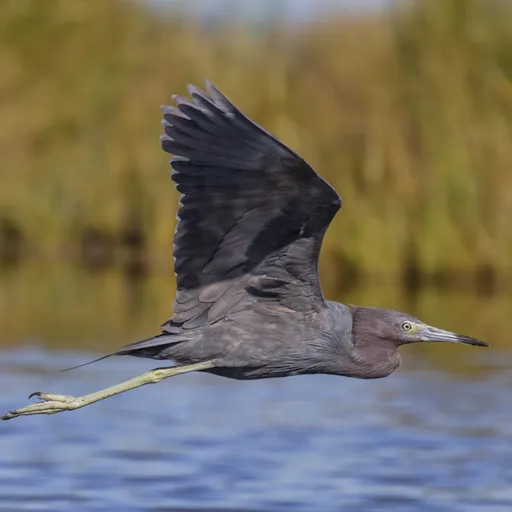
Little Blue Heron
Egretta caerulea
Least Concern
Overview
The little blue heron (Egretta caerulea) is a small, darkly colored heron belonging to the genus Egretta. Although classified as a species of least concern by the IUCN, its population is currently declining, likely due to a combination of habitat disturbance, pesticide exposure, and heavy metal contamination.
Identification
- Small body size of 56–74 cm with a wingspan of 100–105 cm and a weight of approximately 397 g
- Adults feature a two-toned bill that is light blue at the base with black tips, along with yellow eyes and greenish legs
- Adult plumage is generally blue-bodied with a purple-maroon head that turns dark red during the breeding season, accompanied by turquoise lores and long plumes on the crest and back
- Juveniles are almost completely white, resembling the snowy egret, though they possess dark upper primaries and the same two-toned bills
Habitat
The range of Egretta caerulea encompasses much of the Americas, stretching from the United States to northern South America and numerous Caribbean islands. These birds inhabit both freshwater and marine environments, including mangrove forests, bogs, swamps, salt marshes, tidal flats, estuaries, streams, and flooded fields, usually at low elevations though occasionally reaching heights of 3,700 m in the Andes.
Diet
The diet of the little blue heron varies significantly by region, ranging primarily from fish on the eastern coast of North America to being almost exclusively crabs in mangrove forests in southeastern Brazil and southwestern Puerto Rico. Foraging behaviour typically involves standing still and waiting for prey, or walking slowly to search for fish and other small animals, with these herons moving slower than their closely related counterparts.
Did you know?
Little blue herons can hybridise with several other species, including the tricolored heron, little egret, snowy egret, and the black-crowned night heron, with instances of hybridisation with the latter two being noted in locations such as North Dakota and Nayarit.
Sources
- Wikipedia · CC BY-SA 4.0
- Wikidata · CC0 1.0