
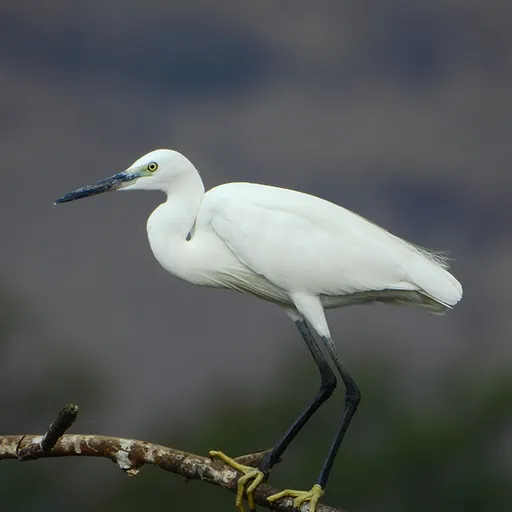
Little Egret
Egretta garzetta
Least Concern
Listen
XC705915 · Sonothèque ADVL · Genêts, Manche, Normandie, France · CC0 1.0
Overview
The little egret (Egretta garzetta) is a species of small heron in the family Ardeidae that is classified as Least Concern on the IUCN Red List. It is a polytypic species found across warm temperate and tropical regions of Asia, Africa, Australia, and Europe, with a range that has recently expanded to include parts of the New World.
Identification
- Plumage is normally entirely white, though dark forms with largely bluish-grey plumage exist; breeding adults feature long, narrow plumes on the nape.
- Size is 55–65 cm in length with a wingspan of 88–106 cm, weighing between 350 and 550 g.
- The bill is long, slender, and black, matching the black legs, while the western race has yellow feet that turn red during courtship.
- The species is mostly silent but produces croaking and bubbling calls at breeding colonies, which are indistinguishable from those of the black-crowned night heron and western cattle egret.
Habitat
This bird inhabits the shores of lakes, rivers, canals, ponds, lagoons, marshes, and flooded land, preferring open locations over dense cover. On coasts, it occupies mangrove areas, swamps, mudflats, and reefs, while rice fields serve as an important habitat in Italy. Its breeding distribution encompasses warm temperate to tropical parts of Asia, Africa, Australia, and Europe, with stable populations now established in the United Kingdom and expanding into the Caribbean and Atlantic coast of the United States.
Diet
The diet consists mainly of fish, but also includes amphibians, small reptiles, mammals, birds, crustaceans, molluscs, insects, spiders, and worms. Foraging methods include stalking prey in shallow water, running with raised wings, shuffling feet to disturb small fish, and standing still to ambush prey. The bird also feeds on creatures disturbed by grazing livestock, consumes ticks on mammals, and scavenges.
Did you know?
The maximum recorded lifespan of a little egret in the wild is around 22.3 years. Its population was once severely depleted in northern Europe due to the 19th-century demand for plumes to decorate hats, an event that helped stimulate the establishment of Britain's Royal Society for the Protection of Birds in 1889.
Sources
- Wikipedia · CC BY-SA 4.0
- Wikidata · CC0 1.0