
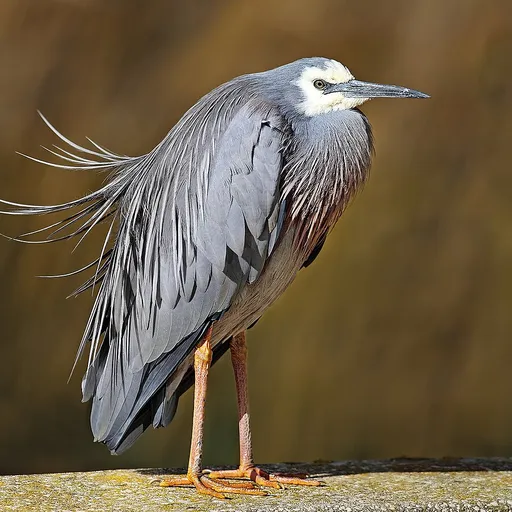
White-faced Heron
Egretta novaehollandiae
Least Concern
Overview
The white-faced heron (Egretta novaehollandiae), also known as the white-fronted heron, is a medium-sized wading bird common throughout most of Australasia. It is found across New Guinea, Indonesia, New Zealand, and all but the driest parts of Australia.
Identification
- Pale, slightly bluish-grey plumage with distinctive white markings on the forehead, crown, chin and upper throat.
- Medium-sized, standing 60 to 70 cm tall, with black lores (the area between the eye and bill) and a black beak that is often pale grey at the base.
- Yellow legs and a flight that is slow and bouncing.
- Vocalisations include a gravelly croak or 'graak' in flight and a 'gow, gow, gow' upon returning to the nest.
Habitat
Found in both fresh and salty wetlands, farm dams, pastures, grasslands, shores, saltmarsh, tidal mudflats, and even suburban gardens or golf courses. It is locally nomadic and is the only heron recorded breeding in Tasmania.
Diet
Feeds on small aquatic creatures, including fish, frogs, small reptiles and insects. It forages using various techniques such as standing still with a rhythmic neck movement, walking slowly in shallow water, foot raking, wing flicking or chasing prey with open wings.
Did you know?
The white-faced heron was self-introduced to New Zealand in the late 1940s.
Sources
- Wikipedia · CC BY-SA 4.0
- Wikidata · CC0 1.0