
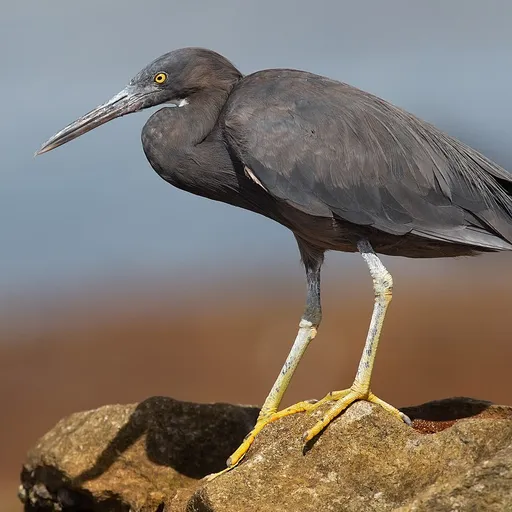
Pacific Reef Heron
Egretta sacra
Least Concern
Overview
The Pacific reef heron (Egretta sacra), also known as the eastern reef heron, is a medium-sized heron found throughout southern Asia and Oceania. Classified as Least Concern on the IUCN Red List, it is characterised by two distinct colour morphs and a wide distribution across coastal and island habitats.
Identification
- Medium-sized heron, 57 to 66 cm in length, with two non-sexual colour morphs: pure white ('light') or charcoal-grey ('dark'), with immatures appearing browner and duller.
- Yellow-grey legs and brown beak, with gold-yellow eyes and a greenish to yellow cast on the surrounding facial areas.
- The grey morph features a narrow white stripe on the throat and chin, while sexes are similar in appearance.
- Hunting behaviour involves standing motionless in shallow water with wings opened like an umbrella to reduce reflections and create shade.
Habitat
Widely distributed across southern Asia and Oceania, the species inhabits most of the coastline and offshore islands in Australia, including the Torres Strait Islands, and ranges from Bangladesh and Japan to Polynesia and New Zealand. It breeds in colonies within jungle environments, situated between palms and mangroves or in the cavities of old buildings.
Diet
Diet consists predominantly of ocean-based fish, crustaceans, molluscs, and worms. This heron hunts during both day and night, timing its foraging to the rise and fall of the tides, and employs a unique daytime strategy of standing motionless with wings open to attract fish by reducing reflections.
Did you know?
The species displays an unusual, non-sexual dimorphism where plumage colour varies between individuals, a phenomenon the reason for which remains unknown but is most commonly thought to be related to camouflage. It was named by Johann Friedrich Gmelin after a specimen described as the "Sacred heron" that was collected in Tahiti.
Sources
- Wikipedia · CC BY-SA 4.0
- Wikidata · CC0 1.0