
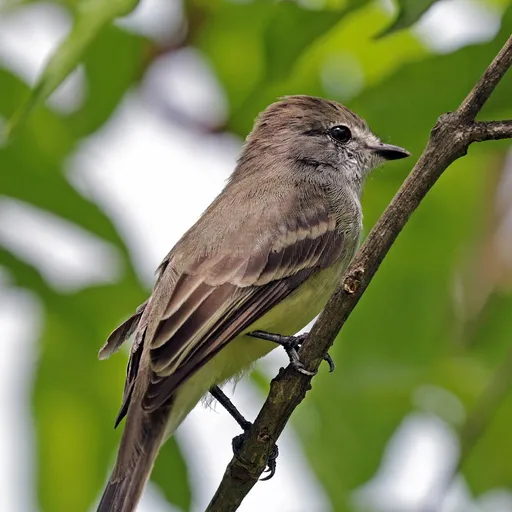
Lesser Elaenia
Elaenia chiriquensis
Least Concern
Listen
XC246362 · Niels Krabbe · Zamora-Chinchipe: Bellavista, Palanda-Zumba road, Ecuador · CC BY-SA 4.0
Overview
The lesser elaenia (Elaenia chiriquensis) is a small songbird belonging to the tyrant flycatcher family. It is classified as Least Concern on the IUCN Red List due to its extensive range and stable population of at least five million mature individuals.
Identification
- Measures 13 to 14 cm in length with a small squarish crest and grayish olive upperparts.
- Features lighter cheeks, a thin whitish eyering, and two wide white wing bars formed by the tips of coverts.
- Underparts range from a gray throat and grayish olive breast to pale yellow bellies, with the albivertex subspecies being paler below.
- Possesses a black bill with a pinkish base, black legs, and dark brown irises.
- Dawn song consists of a high, hurried 'tju-wee tju-weederwee' where the 'wee' notes are higher than the rest.
Habitat
Found in a highly disjunct distribution across Central America, South America, and Trinidad, inhabiting a variety of open and semi-open tropical landscapes. These include scrublands, cerrado, light woodlands, secondary forest, and savanna grasslands with scattered shrubs. Elevation tolerances vary by region, reaching up to 3,000 m in Venezuela.
Diet
Feeds primarily on insects and berries, with berries apparently dominating its diet in central Brazil. It forages singly or in pairs from the upper understory, typically gleaning while perched, hovering briefly, or making short sallies to catch prey on the wing. The species rarely joins mixed-species feeding flocks.
Did you know?
The species is tolerant of converted and secondary habitats, which likely contributes to its security despite threats such as fires and cattle browsing in dry forests. In Panama, the female solely builds the nest, a cup of plant fibers, leaves, and moss, before exclusively incubating the clutch for 14 to 15 days.
Sources
- Wikipedia · CC BY-SA 4.0
- Wikidata · CC0 1.0