
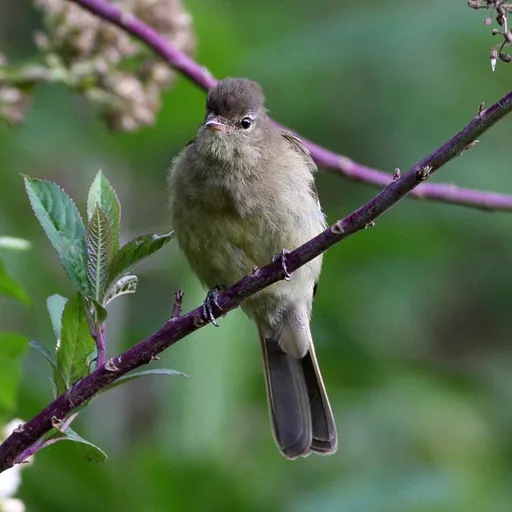
Highland Elaenia
Elaenia obscura
Least Concern
Listen
XC250322 · Niels Krabbe · Loja: 2 km E Cariamanga, Ecuador · CC BY-SA 4.0
Overview
The highland elaenia, Elaenia obscura, is a species of tyrant flycatcher found in the Andes of South America. It is currently classified as Least Concern by the IUCN, with a large range and a stable population, despite being rare and local in some areas.
Identification
- Size: Medium-sized bird, 16–19 cm long, described as a large elaenia without a crest.
- Plumage: Adults have dark grayish-olive upperparts with yellowish tips on the wing coverts forming two bars on the closed wing; the head is dark grayish-olive with lighter cheeks, a dusky loral spot, and a thin whitish eyering.
- Underparts: Pale yellow chin and throat, dull olive breast and flanks, and pale yellow belly and undertail coverts.
- Features: Stubby black bill with a pinkish base to the mandible, dark brown iris, and black legs.
- Song: A variation of the phrase "weehr-drrrr-whee," sometimes with short notes or whistles; the call is a rising-falling or descending "breerr".
Habitat
Found on the east slope of the Andes from southern Ecuador through Peru and Bolivia to northwestern Argentina. It inhabits the undergrowth and edges of humid subtropical and temperate forests, secondary forests, and stunted cloud forest, tolerating rather disturbed and fragmented habitats. Elevation ranges vary by country, from 1,400 m in Peru to 3,000 m in Ecuador, Bolivia, and Argentina.
Diet
The highland elaenia feeds primarily on insects and berries. It forages near the top of the forest canopy while remaining hidden, utilizing methods such as gleaning from perches, brief hovering, and short upward sallies to catch insects in mid-air.
Did you know?
The species is notable for its tolerance of human-modified landscapes, as it readily accepts rather disturbed habitats and fragmented areas. Its song varies across its range, serving as a local identifier despite the variation.
Sources
- Wikipedia · CC BY-SA 4.0
- Wikidata · CC0 1.0