
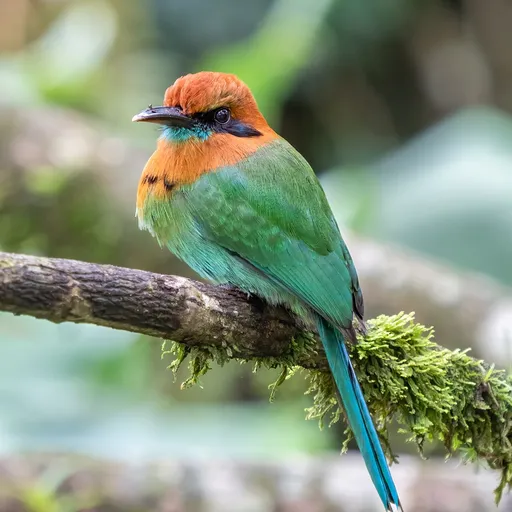
Broad-billed Motmot
Electron platyrhynchum
Least Concern
Listen
XC958125 · Beth Cottam · Rio Tuis ZP- near Rancho Naturalista, Costa Rica · CC0 1.0
Overview
The broad-billed motmot (Electron platyrhynchum) is a small, nonmigratory bird belonging to the family Momotidae, native to Central and South America. It is a sedentary species typically observed in singles or pairs across its range.
Identification
- Approximately 12 inches long and weighing 60 grams, it is one of the smallest members of the Momotidae family.
- Features a cinnamon-rufous upper body and head, with black patches on the cheeks, auricular area, and centre of the chest, while the lower body transitions from greenish to bluish.
- Possesses a distinctive broad, flattened black bill with serrated edges and a keel on the upper mandible, paired with dark eyes and feet.
- Exhibits a long tail that grades from blue to black, including two racquet-shaped central feathers that are significantly longer than the rest.
- Vocalisations include a nasal 'cwaah' song given at dawn, and a less common quiet 'tuk' call that may develop into a rattle.
Habitat
This species resides in humid forests, warm lowlands, and foothills at elevations below 3,000 ft (910 m). Its range covers the eastern side of Central America from Honduras to Panama, extending into north-western South America including Colombia, Ecuador, Peru, Bolivia, and Brazil.
Diet
Primarily insectivorous, the broad-billed motmot feeds on insects, larvae, spiders, centipedes, scorpions, and small vertebrates such as snakes, frogs, and lizards. It does not consume fruit, unlike other members of its family, and will predominantly eat cicadas when they are abundant. Hunting involves perching and observing the surroundings before performing a 'sally-strike' to snatch prey.
Did you know?
Three of its six subspecies, known as the 'plain-tailed motmots', are so distinct that some classify them as a separate species entirely. This distinction is notable because they lack the tail racquets found in other variants.
Sources
- Wikipedia · CC BY-SA 4.0
- Wikidata · CC0 1.0