
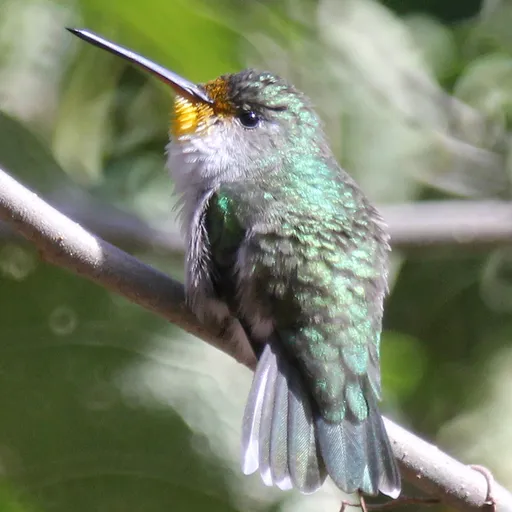
White-bellied Hummingbird
Elliotomyia chionogaster
Overview
The white-bellied hummingbird (Elliotomyia chionogaster) is a species of hummingbird found in South America, belonging to the tribe Trochilini of subfamily Trochilinae. It is generally a sedentary bird, though some local dispersal occurs in Argentina, and is currently assessed as being of Least Concern by the IUCN.
Identification
- 9 to 12 cm long, with males weighing 4.9 to 6.7 g and females 4.5 to 6 g.
- Males of the nominate subspecies display brilliant light green upperparts, sides, and chest, with whitish undersides featuring golden-green spots on the throat sides.
- Females are similar to males but possess a light cream chin and throat that are more heavily spotted.
- Subspecies E. c. hypoleuca has creamy underparts rather than white, with reduced white on outer tail feather webs.
- Medium-length straight bill with a blackish maxilla and a reddish mandible with a dark tip.
Habitat
Found in Argentina, Bolivia, Brazil, and Peru, the species inhabits semi-open landscapes such as forest edges, secondary forest, shrublands, cerrado, plantations, and gardens. It favours relatively dry areas featuring Cactaceae, Agave, or groves of Alnus or Eucalyptus, typically at elevations between 450 and 2,000 m.
Diet
The bird forages for nectar from a wide variety of flowering plants, shrubs, and trees, drawing from at least eight plant families. It also supplements its diet with small insects.
Did you know?
The breeding season spans from January to March, during which the female builds a cup nest from plant wool and moss with lichens on the outside, usually placing it in a shrub or small tree between 2 and 5 m above the ground.