
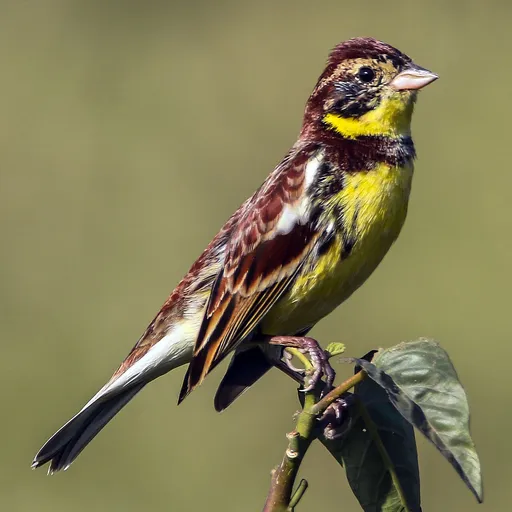
Yellow-breasted Bunting
Emberiza aureola
Critically Endangered
Overview
The yellow-breasted bunting, Emberiza aureola, is a small passerine bird in the family Emberizidae found across the Boreal and East Palearctic regions. It is classified as Critically Endangered following a rapid decline in population sizes due to heavy hunting pressure.
Identification
- A small, stocky bunting measuring 14 to 16 cm in length.
- Breeding males feature bright white underparts with black flank streaks, brown upperparts, a black face and throat bar, and a pink lower mandible.
- Females display a heavily streaked grey-brown back, less intensely yellow underparts, and a whitish face with dark crown, eye, and cheek stripes.
- The call is a distinctive 'zick', while the song is a clear 'tru-tru, tri-tri'.
Habitat
This migratory species breeds in boreal forests and open scrubby areas, such as dry water rice fields and reedbeds, ranging from Finland to the Bering Sea and the Amur River region. It winters in large flocks in cultivated areas, rice fields, and grasslands across south-east Asia, India, and North Korea. It occasionally appears as a rare wanderer in western Europe, the Aleutian Islands, and Labrador.
Diet
The bird primarily feeds on seeds, though it consumes insects when feeding its young. It forages in open scrubby areas and rice fields, often utilising reedbeds for roosting.
Did you know?
Birds are often flushed and caught in mist-nets to be sold for consumption in southern China as 'sparrows' or 'rice birds'. This targeted hunting pressure has driven the species to a critically endangered status.
Sources
- Wikipedia · CC BY-SA 4.0
- Wikidata · CC0 1.0