
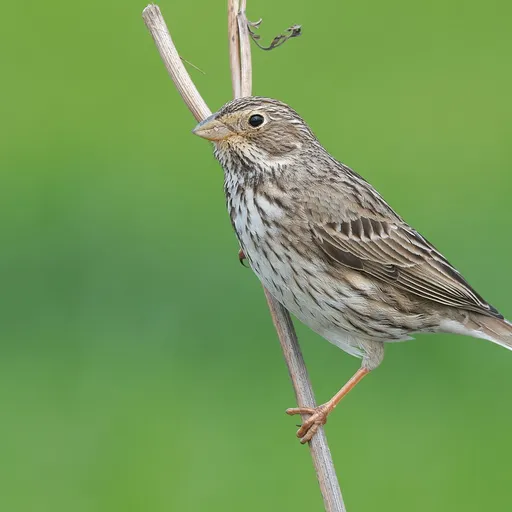
Corn Bunting
Emberiza calandra
Least Concern
Listen
XC707698 · Sonothèque ADVL · Carolles, Manche, Normandie, France · CC0 1.0
Overview
The corn bunting (Emberiza calandra) is a large, bulky passerine bird in the bunting family Emberizidae. It is characterised by its plain appearance and a range that extends from Western Europe and North Africa across to northwestern China.
Identification
- Heavily streaked buff-brown plumage with whitish underparts, giving the bird a lark-like appearance.
- Size ranges from 16–19 cm, with males approximately 20% larger than females.
- Features a conspicuously dark eye and yellowish mandibles.
- The male's song is a repetitive metallic sound often compared to jangling keys, usually delivered from a low bush, fence post, or telephone wires.
Habitat
It inhabits open country with trees, such as farmland and weedy wasteland. While mainly resident across its range, some populations in colder regions of central Europe and Asia migrate southwards in winter.
Diet
The bird's natural food consists mainly of seeds, but it also consumes insects such as crickets, which are especially vital when feeding young.
Did you know?
Males can be polygynous, maintaining up to three females per breeding male, though they contribute little to parental care by skipping nest building and incubation, only joining to feed chicks once they are over half grown.
Sources
- Wikipedia · CC BY-SA 4.0
- Wikidata · CC0 1.0