
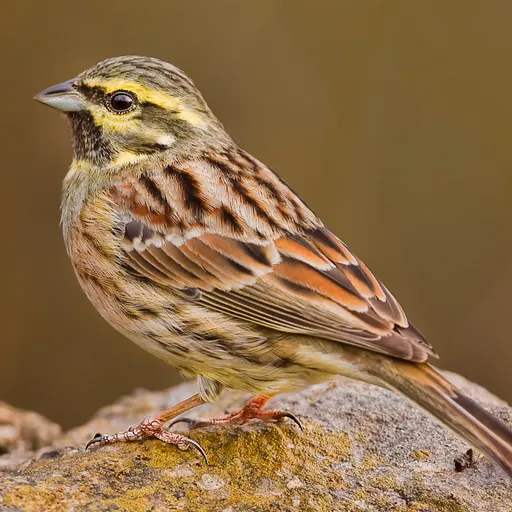
Cirl Bunting
Emberiza cirlus
Least Concern
Listen
XC707694 · Sonothèque ADVL · Carolles, Manche, Normandie, France · CC0 1.0
Overview
The cirl bunting (Emberiza cirlus) is a passerine bird in the bunting family, Emberizidae, that is distinct from finches. It is a resident species across southern Europe, Mediterranean islands, and North Africa, and maintains a small, conserved population in south Devon, England.
Identification
- Approximately 15.5 cm long with a thick, seed-eating bill.
- Males feature a bright yellow head with a black crown, eyestripe, and throat, contrasted by a greenish breast band and heavily streaked brown back.
- Females resemble yellowhammers but are distinguished by a streaked grey-brown rump and chestnut shoulders.
- The male's song is a monotonous, rattling trill similar to that of an Arctic warbler or the terminal rattle of a lesser whitethroat.
Habitat
It thrives in open areas with scrub or trees, showing a preference for sunny slopes, and can tolerate urbanisation, even nesting in green spaces within cities like Rome. Its ideal agricultural habitat consists of mixed grass and arable fields divided by thick hedgerows and dense scrub. The species is largely sedentary, often foraging within 250 metres of its nest in summer and up to 2 kilometres away in winter.
Diet
During summer, the species forages for invertebrates such as grasshoppers and crickets to feed its chicks. In winter, it switches to feeding on small seeds from over-wintered stubbles, fallow land, and set-aside areas. Winter foraging is typically conducted in flocks.
Did you know?
The specific name cirlus derives from the local Italian name cirlo, originating from the word zirlare, meaning 'to chirp', while the English term 'cirl' likely comes from the same root, implying a whistle similar to that of a thrush.
Sources
- Wikipedia · CC BY-SA 4.0
- Wikidata · CC0 1.0