
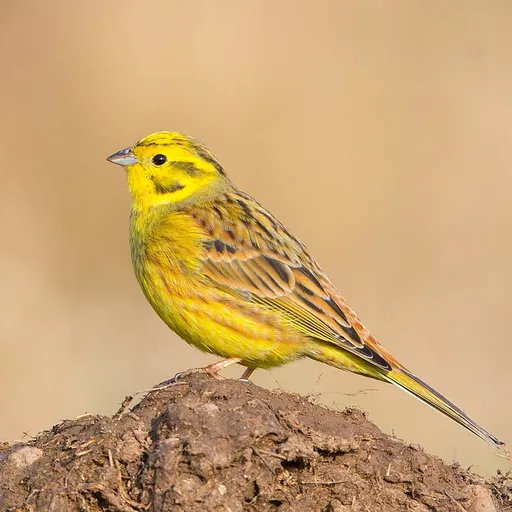
Yellowhammer
Emberiza citrinella
Least Concern
Listen
XC804969 · Sonothèque ADVL · Jullouville, Manche, Normandie, France · CC0 1.0
Overview
The yellowhammer (Emberiza citrinella) is a passerine bird in the bunting family, native to Eurasia and introduced to New Zealand and Australia. It is the commonest and most widespread European bunting, though it is absent from high mountains, Arctic regions, and Mediterranean coastal areas. Most European birds remain in their breeding range year-round, while the eastern subspecies is partially migratory.
Identification
- A large bunting measuring 16–16.5 cm in length, with a wingspan of 23–29.5 cm and a weight of 20–36.5 g.
- Males display a bright yellow head, heavily streaked brown back, rufous rump, and yellow underparts, while females are duller and more streaked.
- The male's song is a series of short notes increasing in volume, often described as "A little bit of bread and no cheese," which can be confused with the pine bunting.
- Distinguishing features from similar species include a yellow tint to the plumage, a paler rufous rump, and more uniform upperparts compared to the pine bunting.
Habitat
The yellowhammer favours dry, open country with a variety of vegetation types and trees for singing, such as traditional agricultural land with hedges and clumps of trees. It is absent from urban areas, forests, and wetlands, and breeds across the Palearctic between the 16–20 °C July isotherms. The species has also been successfully introduced to New Zealand, South Africa, and the Falkland Islands.
Diet
Foraging mainly takes place on the ground, often in flocks that can number hundreds during the non-breeding season. The diet consists primarily of seeds, with a preference for starchy grains like wheat and oats over oily seeds such as brassicas. In the breeding season, invertebrates such as caterpillars, beetles, and grasshoppers are added to the diet, initially feeding chicks exclusively on these before introducing cereal grains to aid physiological adjustment.
Did you know?
The bird gained the historical names "scribble lark" or "writing lark" because the fine, dark mesh of lines on its eggs was believed to carry a concealed, possibly evil message, leading to satanic associations and persecution. Its song has also influenced classical music, with Beethoven reportedly drawing inspiration for parts of his 5th Symphony and other works from the yellowhammer's call.
Sources
- Wikipedia · CC BY-SA 4.0
- Wikidata · CC0 1.0