
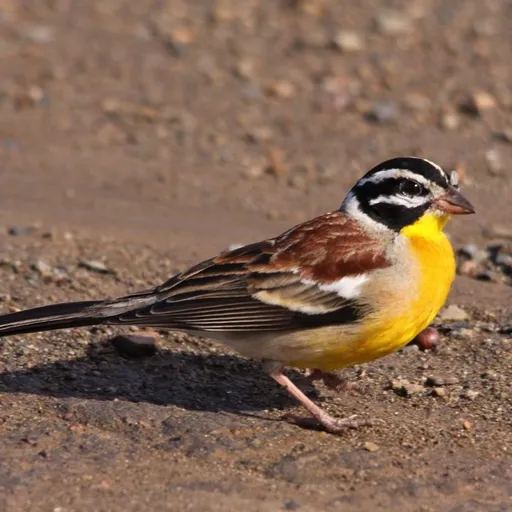
Golden-breasted Bunting
Emberiza flaviventris
Least Concern
Listen
XC611510 · paulo kivuyo · kikatiti, Meru, Arusha Region, Tanzania · CC BY-SA 4.0
Overview
The golden-breasted bunting (Emberiza flaviventris) is a passerine bird in the bunting family that occurs in dry open woodlands and moist savanna across Africa south of the Sahara. It is generally resident, though some local movement may occur, and is classified as Least Concern by the IUCN.
Identification
- Size of 15–16 cm with a striking head pattern featuring a white crown, black lateral crown stripes, white supercilium, and black-bordered white ear coverts.
- Orange-yellow underparts transitioning to yellow on the throat and whitish on the lower belly, contrasting with chestnut upperparts, a grey rump, and two conspicuous white wing bars.
- A nasal ascending call described as 'zzhrr' and a variable song that includes 'weechee weechee weechee'.
Habitat
This species inhabits a variety of open woodlands and moist savanna in Africa south of the Sahara, specifically avoiding the equatorial forest belt. It is found across a range from the Cape to southern South Sudan, with a discontinuous distribution in the Sahel and parts of southern Angola and Namibia.
Diet
The golden-breasted bunting feeds on the ground on seeds, insects, and spiders. Animal prey is taken mostly when the birds have young.
Did you know?
Despite being a wild bird, the golden-breasted bunting is often quite tame. It builds untidy cup nests lined with fine grass or hair low in shrubs or saplings, typically laying two or three glossy white or cream eggs marked with black lines.
Sources
- Wikipedia · CC BY-SA 4.0
- Wikidata · CC0 1.0