
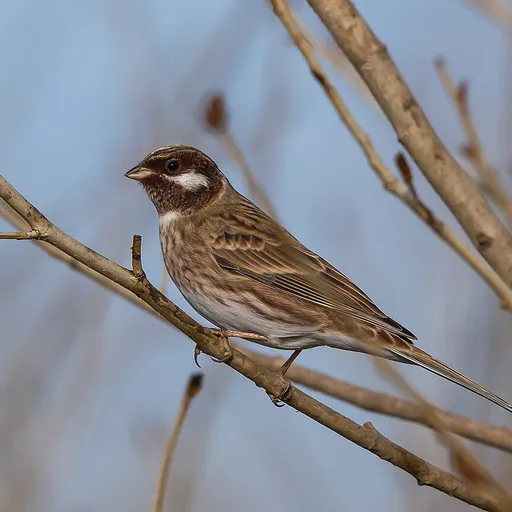
Pine Bunting
Emberiza leucocephalos
Least Concern
Listen
XC1010995 · steve · Улаанбаатар, Налайх Дүүрэг, Улаанбаатар, Mongolia · CC BY-SA 4.0
Overview
The pine bunting (Emberiza leucocephalos) is a passerine bird in the bunting family Emberizidae, a group most modern authors now separate from the finches. It is a robust species native to Eurosiberia east of the Urals, currently classified as Least Concern on the IUCN Red List.
Identification
- A robust bird measuring 16–17.5 cm with a thick, seed-eater's bill.
- The male displays a white crown and cheeks, a chestnut forehead and throat, and a heavily streaked brown back.
- Females are duller and more streaked on the undersides, while non-breeding plumage resembles a yellowhammer but with white replacing the yellow.
- Song and calls are similar to those of the yellowhammer.
Habitat
It breeds across much of temperate Asia and migrates south to central Asia, north India, and southern China in winter. The species favours open land with some scrub or trees, including cultivation, but shows a greater preference for open forest, usually pines, than the closely related yellowhammer.
Diet
Its natural food consists of seeds, and when feeding its young, it consumes insects. The nest is constructed on the ground, and four to six eggs are laid, featuring the hair-like markings characteristic of buntings.
Did you know?
The species is a rare vagrant to western Europe, but it often winters in north-east Italy and Tuscany. Notably, the "Sizewell bunting," a pine bunting × yellowhammer hybrid found in Suffolk, England, in 1982, is documented and illustrated in British Birds.
Sources
- Wikipedia · CC BY-SA 4.0
- Wikidata · CC0 1.0