
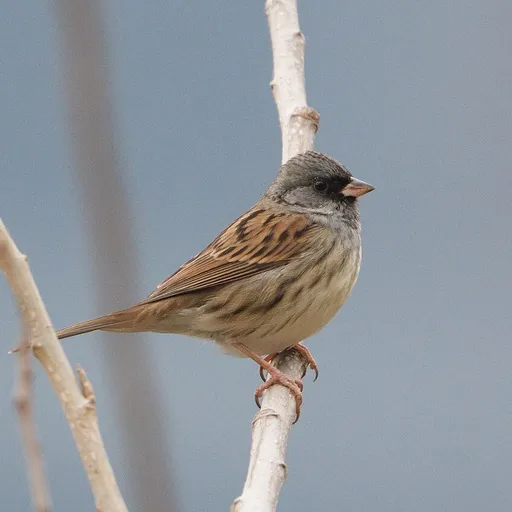
Black-faced Bunting
Emberiza spodocephala
Least Concern
Listen
XC936000 · Jochem Verweij · Khurkh Bird Ringing Station, Биндэр, Хэнтий, Mongolia · CC BY-SA 4.0
Overview
The black-faced bunting (Emberiza spodocephala) is a passerine bird in the family Emberizidae, often compared to a dunnock with a bunting's bill. It is a migratory species that is considered a very rare vagrant to western Europe, currently listed as Least Concern by the IUCN Red List.
Identification
- Similar in size to a reed bunting at approximately 16 cm long.
- The breeding male features a dark grey head with a mix of yellow-green and black between the bill and eye, while the upperparts are brown and heavily streaked with black except on the rump.
- Underparts are yellowish white with fine dark brown flank streaks, and the stout bill is pink.
- The call is short and described as "metallic", sounding like a tzii or tzee.
Habitat
This species breeds in the taiga zone across southern Siberia to northern China, favouring dense undergrowth along streams and rivers. During the winter, it resides in north-east India, southern China, and northern south-east Asia, where it stays close to water in agricultural or open bushy habitats.
Diet
Its natural food consists primarily of seeds, but it switches to insects when feeding its young. The bird exhibits terrestrial feeding habits.
Did you know?
The specific name spodocephala derives from Ancient Greek words meaning "ash-headed", likely referring to the bird's dark grey head.
Sources
- Wikipedia · CC BY-SA 4.0
- Wikidata · CC0 1.0