
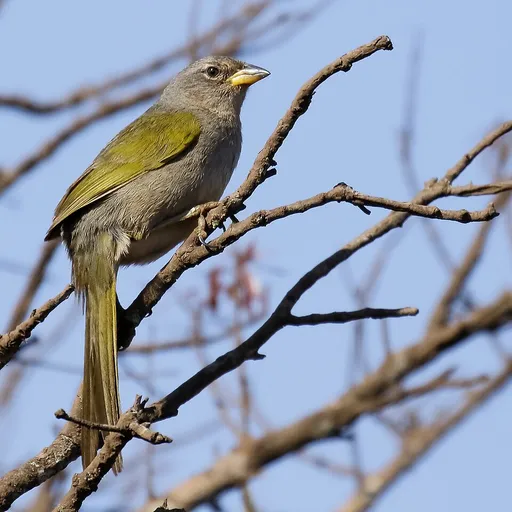
Serra Finch
Embernagra longicauda
Least Concern
Overview
The serra finch, also known as the pale-throated Pampa-finch (Embernagra longicauda), is a monotypic species in the tanager family Thraupidae. It is endemic to Brazil, where it is considered uncommon to rare within its core range but is currently listed as Least Concern on the IUCN Red List.
Identification
- Length of approximately 21.5 cm with short wings, a long tail, and a long, thick bill.
- Grey head featuring a dark eye-line, a pale spot above the lores, and white crescents above and below the eye.
- Greenish-grey upperparts with wings and tail feathers edged in bright grass-green.
- Song consists of a loud 'tsi, tsoweee' repeated every 4–5 seconds, often sung in duet by pairs.
Habitat
This species inhabits campos rupestres, a biome consisting of grasses, open woodlands, and rock outcroppings, where it prefers scrubby areas and woodlands over open grassland. Its range covers eastern Brazil from central Bahia south to southern Minas Gerais, with scattered records in Espírito Santo and at elevations between 700 and 2,100 m.
Diet
The serra finch feeds primarily on arthropods and fleshy fruits, supplemented by some dry seeds. Pairs and family groups forage on the ground.
Did you know?
The shiny cowbird (Molothrus bonariensis) acts as a brood parasite on this species. The serra finch builds an unlined open cup nest of grasses, typically placed very low in a shrub just 0.3 to 0.6 m above the ground.
Sources
- Wikipedia · CC BY-SA 4.0
- Wikidata · CC0 1.0