
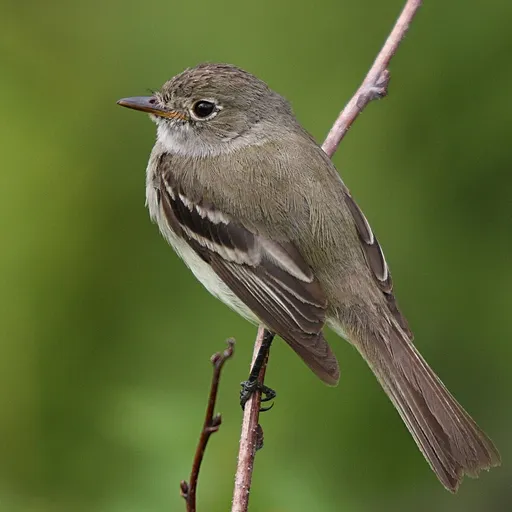
Alder Flycatcher
Empidonax alnorum
Least Concern
Overview
The alder flycatcher (Empidonax alnorum) is a small, insect-eating bird belonging to the tyrant flycatcher family. It is classified as a species of least concern by the IUCN Red List, although population numbers have declined significantly in Canada.
Identification
- Upperparts are dull greenish-olive, with a slightly darker crown and a white throat featuring a darker breast band.
- Features thin white eye-rings, a wide bill with a black upper mandible and a pinkish or yellow-orange lower mandible, and black wings with white wing bars.
- Length ranges from 13–17 cm with a wingspan of 21–24 cm, and weight between 12–14 g.
- The song is a distinct "fee-bee-o" often accompanied by the bird throwing its head back and shaking its tail.
Habitat
In summer, it breeds in wet, dense thickets of young alder, maple, and birch from sea level up to 1,300 m across most of Canada, Alaska, and the northeastern United States. During winter, it occupies early successional scrubby vegetation or woodland edges near water in the western range of South America, typically below 1,100 m.
Diet
The diet consists primarily of insects such as sawflies, bees, wasps, ants, beetles, flies, butterflies, moths, and crickets. These are captured in flight or gleaned from tree foliage, with some individuals also consuming fruit and seeds in winter.
Did you know?
The specific name alnorum is derived from Latin and specifically means "of the alders", highlighting the bird's strong association with this type of vegetation during the breeding season.
Sources
- Wikipedia · CC BY-SA 4.0
- Wikidata · CC0 1.0