
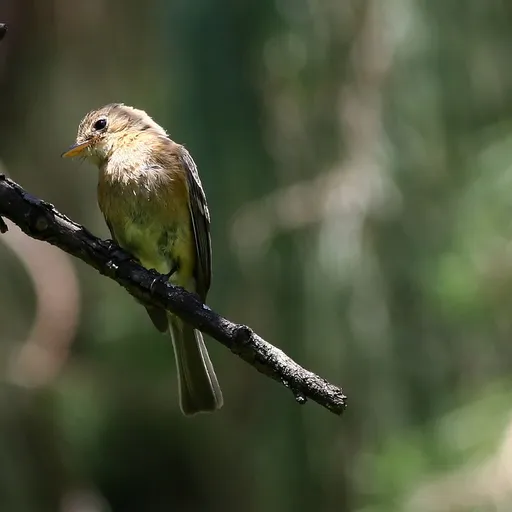
Buff-breasted Flycatcher
Empidonax fulvifrons
Least Concern
Overview
The buff-breasted flycatcher, Empidonax fulvifrons, is a small passerine bird in the family Tyrannidae. It is the smallest member of its genus in the United States and one of the smallest overall. The species is classified as Least Concern by the IUCN, with an estimated population of at least two million mature individuals.
Identification
- Approximately 13 cm long, weighing 6.9 to 9.3 g, with sexes appearing alike.
- Dull buffy white lores and a faint eye-ring on a buffy greenish brown face, with a darker buffy greenish brown crown and upperparts.
- Deep chestnut-brown irises, a black maxilla, a yellow-orange mandible, and black legs and feet.
- Tawny buff breast with light yellowish buff underparts, and wings featuring two pale wing bars.
Habitat
The bird inhabits wide mountain canyons with open pine, pine-oak, and oak forest that have a grassy understory with some bushes, often near watercourses. In non-breeding seasons, some individuals move to lower elevation thorn-scrub. Its distribution is disjunct, ranging from the southwestern United States to Honduras, between 600 and 3,500 m elevation.
Diet
The buff-breasted flycatcher feeds primarily on insects. It forages from the forest's understory to the mid-story and on the ground, capturing prey in mid-air with sallies from a perch, known as hawking. It typically forages in pairs during the breeding season and singly outside that period.
Did you know?
The female constructs the open cup nest alone, binding small rootlets and leaves with spiderweb and decorating the exterior with feathers, larger leaves, lichen, and bark. While the female incubates the three or four eggs and broods the nestlings alone, both parents participate in provisioning them after hatching.
Sources
- Wikipedia · CC BY-SA 4.0
- Wikidata · CC0 1.0