
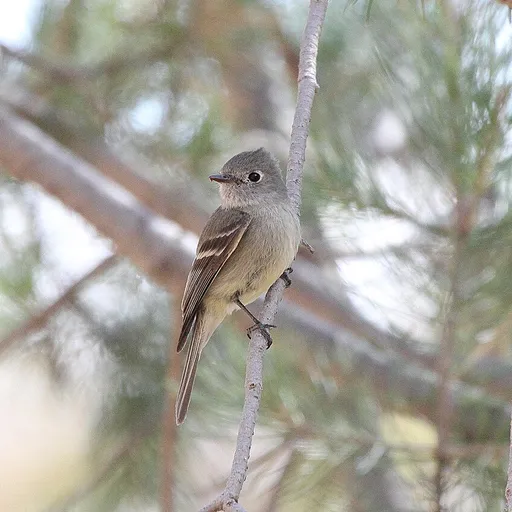
Hammond's Flycatcher
Empidonax hammondii
Least Concern
Overview
Hammond's flycatcher (Empidonax hammondii) is a small, insectivorous flycatcher that inhabits coniferous and mixed forests across western North America. Classified as Least Concern on the IUCN Red List, this migratory species breeds in the west of the United States and Canada before wintering in Mexico and Central America.
Identification
- Adults measure 12–14 cm in length with a wingspan of approximately 22 cm and weigh between 8 and 12 g.
- Plumage features greyish-olive upperparts, darker wings and tail, and whitish underparts washed with grey on the breast and yellow on the belly sides.
- Distinguishing marks include a conspicuous white eye ring, white wing bars, a small bill, and a short tail.
- The song is a multi-versed, hoarse ssilit, greeep, silit, pweet, accompanied by a sharp peek call.
Habitat
This species prefers mature coniferous and mixed forests, specifically dense fir, conifer, and aspen woods, as well as dogwood thickets. Its breeding range covers western North America, including specific US states such as Montana, Wyoming, California, Oregon, Nevada, Utah, Arizona, New Mexico, and Colorado, along with Canadian provinces and territories like British Columbia, Yukon, and Alberta, with some individuals found as far north as Alaska.
Diet
Their diet primarily consists of beetles, flies, bees, butterflies, and moths, typically averaging 5.7 mm in length. Foraging behaviour includes hawking, where they wait on open perches in the upper parts of trees to catch insects in flight, and gleaning, where they pluck insects from foliage while hovering.
Did you know?
Male Hammond's flycatchers physically fight during the breeding season by locking themselves together in midair and fluttering to the ground. Additionally, birds on Vancouver Island have evolved longer, thicker bills due to the absence of the competing Western flycatcher in that specific niche.
Sources
- Wikipedia · CC BY-SA 4.0
- Wikidata · CC0 1.0