
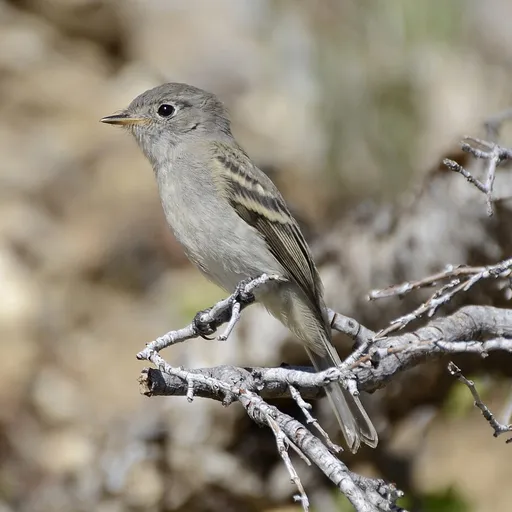
American Dusky Flycatcher
Empidonax oberholseri
Least Concern
Overview
The American dusky flycatcher, or simply dusky flycatcher, is a small insectivorous passerine of the tyrant flycatcher family. It is classified as Least Concern on the IUCN Red List.
Identification
- Olive-gray upperparts, darker on the wings and tail, with whitish underparts.
- A noticeable medium-width white eye ring, white wing bars, and a medium-length tail.
- The breast is washed with olive-gray, and the bill is mainly dark.
- It is slightly smaller than the American grey flycatcher and larger than the Hammond's flycatcher.
- The male sings a three-part song, often accompanied by a dry 'whit' call or a less common sad 'dew-hic'.
Habitat
Breeding habitat consists of mountain slopes and foothills with brush and scattered trees, especially ponderosa pine, across western North America. These birds migrate to southern Arizona and Mexico, acting as passage migrants over the deserts of the south-western United States, including the Mojave, Sonoran, and Chihuahuan Deserts.
Diet
The species is insectivorous. They often wait on an open perch and fly out to catch insects in flight, a method known as hawking. They will also pluck insects from foliage while hovering, a technique called gleaning.
Did you know?
The species belongs to a genus where members are notoriously difficult to differentiate, with voice, breeding habitat, and range being the best characteristics for distinction. Its scientific name commemorates the American ornithologist Harry Church Oberholser.
Sources
- Wikipedia · CC BY-SA 4.0
- Wikidata · CC0 1.0